

Popular Articles
- Witches Wheel Sigil Generator
- Interdimensional Perspectives on the Enochian Communications
- The Observer Effect
- Faith-Based Medical Neglect
- Quantum Nexus in the Unicursal Hexagram
- Exploring Past Lives, DNA Memories, Soul and Quantum Connections
- Intersections of Quantum Mechanics and Magick
- Cuneiform Glyph Generator
- Witches Do Exist: A Modern Exploration
- Exploring Plasma-Magnetic Dynamics
Technomagickal Archive
Explore an expanding interconnected research library of occult, esoteric, historical, symbolic, scientific, and philosophical correspondences. Search across traditions, concepts, materials, divination systems, cosmology, physics, alchemy, dreams, numerology, and other areas of Technomagickal study. This is not AI driven but based on a locally stored library that we are always expanding on.
Enter the Technomagickal Archive ↗Fear, Doubt, and the Threshold of the Circle
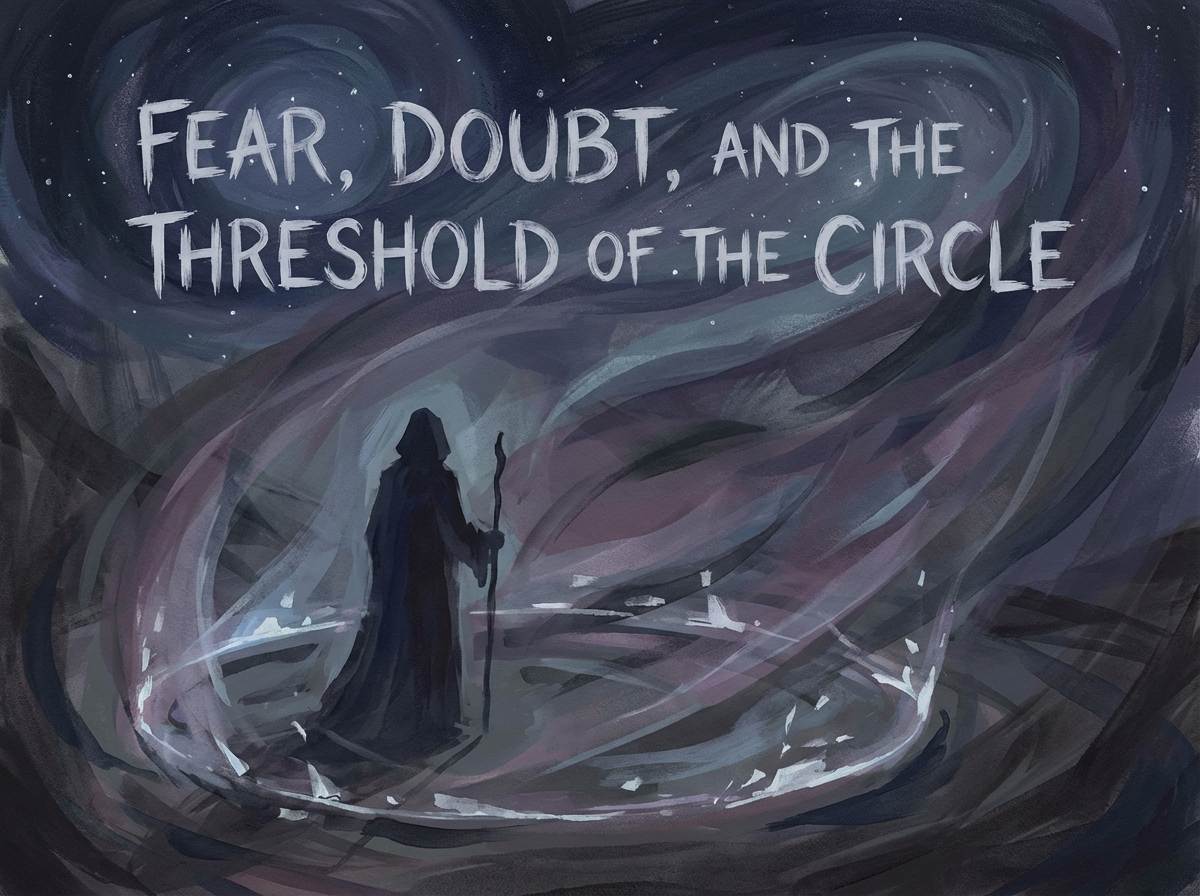
When I was in my early teens, around thirteen years old, I decided that I was finally ready to test everything I had been reading about ceremonial magic. I had spent months studying, copying diagrams, memorizing passages, and convincing myself that if I followed every instruction exactly, I could step into a world that most people only whisper about. The text I was working from insisted that timing was crucial, so when it said the operation had to be done at two in the morning, I took that literally. I waited until the house was quiet, slipped out unnoticed, and began the long walk to the place I had chosen.
The path led me through a patch of forest that, at that hour, felt strangely awake. The trees creaked and shifted in the night air, as if they were conferring over my presence. Vines hung down, brushing against my shoulders and arms as I pushed through, making the whole place feel like it was closing around me. At one point I had to cross a small swampy area, the ground soft and uncertain under my feet, the smell of damp earth and standing water heavy in the darkness. Every sound was amplified: the splash of my step, the buzz of insects, the distant call of some animal I could not see. Yet beneath the unease was a sense of purpose. I was going to do this ritual exactly as written. No shortcuts, no improvisation, no excuses.
Eventually the trees thinned, and I emerged into a clearing I had chosen in advance as my working space. It was an open field, large enough to hold the required circle and still give me room to move. The sky above was dark but clear, the stars unobstructed by the forest canopy. I set down my supplies with a seriousness that, in hindsight, seems almost comical for someone so young, but at the time it felt like I was preparing for the most important exam of my life. I drew the circle according to the precise instructions I had studied, careful to sketch each line and symbol correctly. My robe, my footwear, the tools I carried, the positioning of everything—I followed the book’s directions as if each sentence were a lock that would snap shut on me if I dared to deviate.
This was a Goetic operation, and I approached it with a mixture of awe and naive confidence. I had no desire to adapt, improve, or personalize the process. I believed that safety and success depended on copying the procedure exactly. Once the circle was completed and everything was in place, I began the ritual, reciting the words as accurately and clearly as I could manage. The night pressed in, but the circle felt like a small island of order carved out of a vast unknown. For a while, that sense of structure was comforting. I trusted the pattern, the sequence, the tradition. I trusted the book.
The ritual moved along, step by step, until eventually I reached the final phase: the closing. By that time, a heavy bank of fog had rolled in from the Gulf. That sort of fog was not unusual in that region, yet in that context it changed everything. The field that had been open and clearly defined earlier became murky and half-hidden. Distances felt uncertain. The edges of my circle faded into a soft blur whenever I glanced outward. What might have been an ordinary weather shift earlier in the day now seemed like a deliberate response from the invisible world I was trying to touch. It deepened the atmosphere and intensified the sense that something unseen was moving just beyond my vision.
I began the banishings and closing procedures as the text prescribed, tracing and speaking and visualizing in all the ways I had rehearsed. My heart was pounding, but I told myself that this was normal. Then, as I continued, my eyes landed on a line in the book—a warning I had read before but never really felt: “If you have not done the closing correctly, the hound of hell will drag you to the pit.” It was dramatic language, meant to stress the importance of finishing the ritual properly. In the bright light of day, it would have sounded exaggerated, almost theatrical. At two in the morning, surrounded by fog in a remote field, it suddenly felt very literal.
That single sentence planted a seed of doubt. What if I had mispronounced a word? What if a line of the circle was not quite complete? What if my concentration wavered at a crucial moment and I had not truly sealed things? In the space of a few seconds, the calm confidence I had carried into the operation collapsed. I looked at the boundary of the circle—the line that marked safety—and it no longer felt like a symbol. It felt like a wall between me and some unseen threat that might be lurking just outside. The fog made it worse. I could not clearly see what lay beyond, and my imagination eagerly filled that uncertainty with claws, teeth, and punishment.
I finished the closing, but when the time came to step out of the circle, I froze. My body refused to move. I lifted my foot toward the boundary and felt a surge of fear so strong it was almost physical. The idea that some infernal hound was waiting, just out of sight, ready to drag me into a nameless horror if I had made even the smallest mistake, locked me in place. Rationally, I could have reminded myself that I had been careful, that I had done everything as instructed. But rational thought was no longer in control. Anxiety had taken the wheel, and all I could think was: “What if I got it wrong?”
Instead of crossing the line and walking away, I decided to repeat the banishings. If one closing felt uncertain, surely doing it again would calm me. I went through the process a second time, trying to correct any invisible errors I imagined I might have made. When I finished, I looked toward the edge of the circle. Once more, my courage evaporated as soon as I tried to step across. The warning from the text echoed in my mind. Repeat. Fear. Repeat again. The more I tried to fix the imagined mistake by repeating the procedure, the more power that fear had over me. The circle, which was supposed to be a safe space, became a prison of my own making.
So I did it again. And again. Each repetition was meant to be reassurance, yet each one deepened my doubt. Instead of feeling more certain, I felt even less confident that I had closed correctly. I was afraid I had already made a mistake I could not detect. The fog thickened, or at least it seemed to. The night felt longer. At some point, exhaustion began to set in. I was too tired to think clearly, but still too afraid to step over the boundary. Eventually, my body made the decision that my mind could not: I lay down inside the circle and fell asleep there, still wearing the robe, still surrounded by the symbols I had drawn with such care. That is where the night ended for me.
When I woke, the sun had risen. The fog had burned away, replaced by clear morning light. The field looked ordinary again—just grass, earth, and trees in the distance. The circle was still there, unchanged. Nothing had approached it. No infernal creatures had clawed at the edge. The line I had feared to cross was simply a mark on the ground. In daylight, all the menace I had projected onto that boundary vanished. I stepped across it without a second thought. There was no hound of hell, no sudden punishment, no dramatic consequence. There was only the realization that I had been held in place, not by anything external, but by my own fear and doubt.
That morning became one of the clearest lessons of my life, and it had very little to do with demons or spirits, and everything to do with the inner landscape of the human mind. Standing there in the ordinary light of day, looking at that same circle, I understood that the barrier had been psychological, not magical. The circle had not changed between night and morning. The only thing that had shifted was my perception. In the darkness, surrounded by fog and gripped by the book’s dramatic warning, I gave my fear so much authority that it stopped me from moving forward. In the daylight, the spell was broken, and I could see plainly how much power I had handed over to my imagination.
The deeper part of the lesson is about thresholds. Every meaningful change in life requires crossing some kind of boundary—entering a new situation, leaving an old habit, risking embarrassment, failure, or the unknown. In occult work, that threshold might be literal, like the edge of a ritual circle. In everyday life, it might be a job interview, a difficult conversation, a new path of study, or a personal decision that feels risky. When fear and doubt are allowed to dominate, they swell in size and weight until those thresholds look impossible to cross. You start to believe that if you step forward, something terrible will happen, even if you cannot name exactly what that terrible thing is.
In my case, the threshold was very clear: the edge of a circle drawn in a field. At night, with a dramatic warning echoing in my head, I treated that edge as if it were charged with real, immediate danger. I allowed myself to imagine consequences so extreme that paralysis felt safer than movement. When the sun came up, the truth was obvious. The circle had no power on its own. It was my belief, my terror, and my willingness to accept a worst-case scenario as reality that had turned a simple line into an insurmountable barrier. The same is true in many other areas of life. We often find, when we look back, that the thing blocking us was never as solid as it appeared. It was our own hesitation that made it feel unbreakable.
There is another layer to this lesson as well. That night, I was not only dealing with my own internal doubts; I was also responding to fear presented by an outside authority—the book. The warning about the hound of hell was written to emphasize seriousness and caution, but to a young mind, it became more than a metaphor or a dramatic flourish. It became a threat. This is something that extends beyond ritual and into many systems of belief, social structures, and relationships. When people in positions of authority weaponize fear and uncertainty—whether through religion, ideology, or social pressure—they can hold others in place as effectively as I held myself inside that circle. If you accept their warnings without question, you might find yourself unable to move, not because the world is truly dangerous, but because you have been taught to expect catastrophe if you dare to step outside approved boundaries.
The strongest anchor a person can carry is the fear and doubt they harbor within themselves. These internal states can feel heavier than chains. They are quiet, persistent, and persuasive, especially in moments of vulnerability or darkness. Yet there is an important distinction: an anchor keeps you from drifting, but it also stops you from sailing. Fear and doubt can sometimes protect you from real dangers, but when they are exaggerated or manipulated, they do the opposite of protection—they prevent growth. They stop you from exploring possibilities, from learning, and from discovering what you are actually capable of handling. That night in the circle, I let the anchor drop so deep that I could not move an inch beyond its radius.
Over time, I realized that there is another kind of fear that comes from outside ourselves, projected onto us by others who want to direct or limit our choices. They may warn us about disaster, loss, punishment, or ridicule if we step away from the paths they approve of. That external fear only has power if we accept it and weave it into our own internal narrative. If we allow someone else’s imagined catastrophes to become the story we tell ourselves, then we willingly participate in our own restraint. I had already done something like that with the text I studied. I gave its warning more authority than my own experience and observations. I treated its words as an absolute law, instead of remembering that it was still my choice how much weight to give them.
The lesson I took away from that night is not that ritual circles are meaningless or that warnings should always be ignored. The lesson is that discernment is essential. There is a difference between healthy caution and paralyzing terror. There is a difference between respecting a tradition and surrendering your ability to think critically. There is a difference between acknowledging that the unknown can be unsettling and treating it as a guaranteed source of harm. My young self, trembling at the edge of that circle, could not see those distinctions. The fog outside and the fear inside blended together, and I lost perspective.
Years later, when I think back on that field, that fog, and that stubborn line I would not cross, I see it as an early initiation—not into some infernal realm, but into understanding my own mind. I learned that the unknown is not automatically an enemy. Night and fog do not become more dangerous simply because we cannot see clearly through them. The unseen is part of life, whether we are dealing with spiritual mysteries or just the uncertainty of tomorrow. If we train ourselves to meet everything unseen with panic, we trap ourselves in circles of our own design. If, instead, we learn to acknowledge fear without being ruled by it, we gain the ability to step across thresholds and move forward, even if our legs are shaking while we do it.
That morning, when I finally stepped out of the circle in full daylight, I did not feel heroic. I felt a little foolish, a little relieved, and oddly grateful. I had been given a vivid demonstration of how easily my own thoughts and beliefs could imprison me. It was an uncomfortable realization, but a valuable one. The experience stayed with me as a reminder that whenever I feel frozen at the edge of some decision, it is worth asking: Is there really a hound of hell waiting for me out there, or is that just a phrase, a fear, a story I have let grow too large in my mind? Often, the barrier is not the world itself. It is the part of us that would rather cling to imagined safety than risk crossing into the unknown.
In that sense, the field, the fog, and the circle have become symbols in my memory. They represent all the thresholds we face and all the ways we can either step forward or curl inward, depending on how much power we give to fear and doubt. The night taught me how strong those forces can be when they go unchecked. The morning taught me that they can be dissolved by clarity, perspective, and the simple act of taking a step.