

Popular Articles
- Witches Wheel Sigil Generator
- Interdimensional Perspectives on the Enochian Communications
- The Observer Effect
- Faith-Based Medical Neglect
- Quantum Nexus in the Unicursal Hexagram
- Exploring Past Lives, DNA Memories, Soul and Quantum Connections
- Intersections of Quantum Mechanics and Magick
- Cuneiform Glyph Generator
- Witches Do Exist: A Modern Exploration
- Exploring Plasma-Magnetic Dynamics
Technomagickal Archive
Explore an expanding interconnected research library of occult, esoteric, historical, symbolic, scientific, and philosophical correspondences. Search across traditions, concepts, materials, divination systems, cosmology, physics, alchemy, dreams, numerology, and other areas of Technomagickal study. This is not AI driven but based on a locally stored library that we are always expanding on.
Enter the Technomagickal Archive ↗Primordial Observation
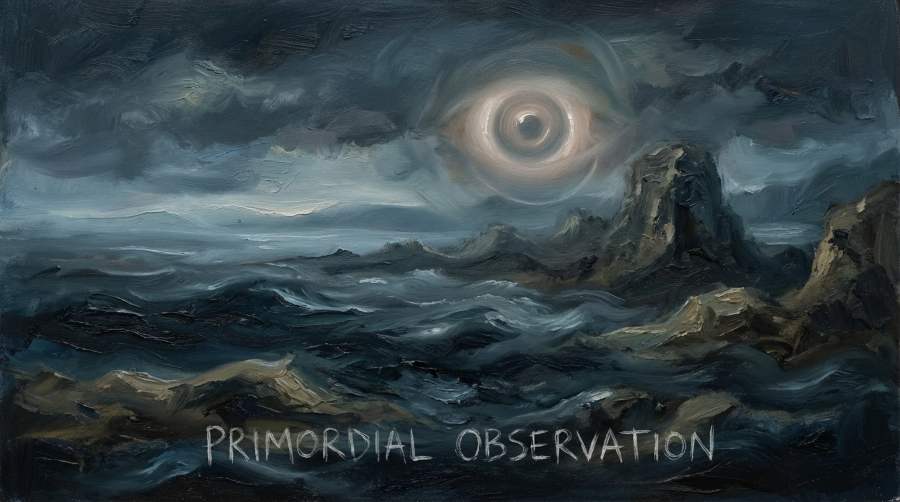
I keep noticing that when I read creation stories from different parts of the world, the first beings do not feel like “people” at all. They are not just gods with personalities, hobbies, and family drama. They are moods, textures, and forces. They are darkness, water, silence, breath, pressure, or a vast empty “somewhere” that is not really a place.
When I step back from the proper names and look only at their attributes, I start to feel like I am meeting the same few beings wearing different cultural masks. It is as if humanity keeps dreaming of the beginning in the same handful of archetypal shapes, and each tradition dresses those shapes in its own language, landscape, and ritual style. Comparative mythologists have noticed this too: across the world, creation myths tend to feature primordial chaos, separation of elements, cosmic waters, and sky–earth divisions.
In this article, I am going to stay mostly with those shapes. I will talk about “the first waters,” “the yawning gap,” “the cosmic egg,” “the world tree,” and “the sacrificed body” instead of focusing on specific names. I will move from region to region, but treat all of these figures as if they are fragments of one vast primordial story that humanity keeps retelling from different angles.
1. Meeting the Primordial: Not Quite a God, Not Quite a Place
When I encounter a primordial figure in myth, it usually does not walk on two legs or sit on a throne. Instead, it is the throne, or the darkness around it, or the ocean beneath it.
Across many traditions, the first “being” is not a person but a condition:
- A formless, dark, watery expanse
- A vague emptiness, a gaping chasm
- A dense, undifferentiated substance
- A silence so total it feels alive
Scholars often talk about this as primordial chaos, not chaos in the sense of random noise, but chaos as an unstructured whole, full of potential but without distinct things yet.
This primordial state often has three key attributes:
- Unformed – there are no boundaries, no “this vs. that”.
- Fertile – everything that will ever exist is somehow already there in seed form.
- Threatening – because if form ever slips, everything might sink back into that undifferentiated state.
Even when myths later personify this state as a deity with pronouns, relationships, and decisions, it still behaves more like a cosmic environment than an individual. In occult language, I would say these figures are closer to fields than to characters. They are the background field of existence that later gods and worlds arise from, like waves rising from an invisible ocean of energy.
Modern cosmology accidentally echoes this. When physicists talk about a quantum vacuum as “full of fluctuations” out of which particles appear, they are using scientific language for something myth already intuited: that apparent emptiness is secretly packed with creative potential.
2. The First Waters: Primordial Ocean as Mother and Menace
One of the most universal ways cultures imagine that first field is as water. Not a normal sea with shorelines and fish, but a limitless, often dark, body of water that surrounds or precedes the world.
Ancient Near Eastern, Egyptian, and many other traditions describe a primordial ocean from which land, gods, and life emerge. That ocean is usually:
- Boundless: no coast, no islands, only water in all directions.
- Deep and opaque: impossible to see through or measure.
- Both womb and grave: the place all things come from and can return to.
In the Nile valley, myth speaks of an infinite dark flood from which the first mound of land rises. Whether that flood is treated as “he” or “she” or a pure “it,” its nature is the same: a watery chaos that holds all possibilities.
In the lands between the Tigris and Euphrates, stories describe mingled waters, fresh and salty, whose interaction eventually births the structured cosmos. Elsewhere, mythic texts that would later influence the Hebrew Bible describe a deep, untamed watery state that has to be separated, tamed, or bordered before a stable world can exist.
From these patterns, I start to see “the first waters” as an archetype with specific qualities:
- They erase distinction. In water, things dissolve, sink, or blend.
- They hold memory. Many cultures place ancestral spirits in or under the water.
- They threaten to overflow. Flood myths often echo the fear that the world could be drowned back into its original state.
In magickal terms, the primordial waters feel like pure subconscious: uncivilized, full of images, terrifying if I am used to neat categories, but absolutely necessary if anything truly new is going to be born.
3. The Yawning Gap and the Egg: Space as a Primordial Deity
Not every tradition starts with water. Some begin with a gap, an emptiness that has weight and presence. Several mythic systems speak of a kind of yawning chasm at the beginning of things, a vast, open “between” where nothing is firmly established.
What fascinates me is that this gap is not just absence. It behaves like:
- A womb waiting to be filled
- A stage before the actors arrive
- A pressure difference that will eventually create movement
Where watery myths speak of density and saturation, gap myths speak of tension. Fire and ice reach into the middle and meet; above and below slowly separate. In both cases, creation comes from contrast.
Then there is the cosmic egg, another cross-cultural favorite. From parts of Asia to Europe and beyond, stories describe a primordial egg floating in the void, containing all opposites, often symbolized as dark and light, heavy and light, or male and female.
The egg has its own distinct attributes:
- Enclosure – everything is compressed into one shell.
- Hidden differentiation – opposites exist, but they are folded together.
- Inevitable rupture – at some point, it has to crack.
When it finally breaks, its shell becomes mountains and earth, its yolk becomes sun, sky, or deities, and its white becomes cloud or sea. Even in later mystical art, the cosmos itself can be drawn as a kind of egg of fire and stars.
For me, the egg is a beautiful bridge between myth and psychology. It is what my life feels like before a big change: everything inside, nothing visible yet, pressure building quietly until something splits and a new structure appears.
4. Sky and Earth: The First Parents as Bodies of the World
Once the primordial field, whether water, gap, or egg, begins to differentiate, another pair of beings appears again and again: a sky parent and an earth parent.
These two are less abstract than the first waters, but still not quite human. They are literally the ground underfoot and the vault of the heavens above. They often start out fused together, pressing everything between them into darkness, until some force pushes them apart, creating room for light, air, and human life. Comparative studies show this “separation of sky and earth” motif across multiple traditions from Oceania to the ancient Mediterranean.
Attributes of this sky–earth pair include:
- Physical vastness – they are the actual body of the world.
- Sexual or creative tension – their union generates other beings.
- Necessary separation – their pulling apart creates space for a middle world.
Occult symbolism reads this pair as the first polarity:
- Above / below
- Spirit / matter
- Intellect / body
In ceremonial and folk magic, I see this when practitioners call on “the powers of the heavens” and “the spirits of the land” as complementary forces. They are still echoing that primordial couple, even if they never name them.
Sometimes, this pair is complemented by a cosmic mountain or primordial mound, the first piece of land to rise out of water. In Egypt and elsewhere, this mound becomes a sacred template for temples. The mound is another face of the primordial: an axis between water below and sky above.
5. The World Tree and the Axis Mundi: When the Primordial Becomes a Path
Once sky and earth exist, many cultures imagine a connecting pillar, tree, or ladder, the axis mundi, the world axis.
The world tree, especially, is almost absurdly universal. It appears in northern Europe, in parts of Mesoamerica, in Siberian shamanism, and in multiple Indo-European traditions. The details change, but the attributes stay strikingly similar:
- Its roots reach into the underworld or primordial waters.
- Its trunk stands in the middle world, where humans live.
- Its branches support the heavens, sun, or deities.
The axis mundi is the primordial field turned into a path. Where the first waters or the first gap simply are, the world tree lets beings move between realms. In occult practice, I see this mirrored in:
- The Qabalistic Tree of Life as a map of ascent and descent.
- Shamanic journeys that climb or descend a central tree or pole.
If the primordial ocean is the ground of being, the world tree is the nervous system of the cosmos. It does not just exist; it conducts. It turns stillness into circulation, of souls, of power, of messages between above and below.
6. The Sacrificed Body: World as Corpse of the First Being
Another pattern I keep encountering is the idea that the world is made from the body of a primordial being. This being might be giant, dragon, or cosmic person, but the pattern is the same:
- The first being is dismembered or dies.
- Body parts become elements of the world, bones as mountains, blood as oceans, hair as plants.
- The world is therefore literally made of divinity.
We see versions of this motif in several mythic families, where a primordial worker of creation dies and the body becomes the landscape.
Unlike the earlier more impersonal waters or gaps, this figure usually has a clear individuality. But it still acts more like a principle than a personality. Its main attribute is sacrifice, sometimes voluntary, sometimes forced, but always world creating.
On an occult level, I read this as a statement about transformation:
- Something total must be broken apart.
- Its unity is lost, but its pieces become the building blocks of a more complex cosmos.
- Life, in this view, is literally stitched out of death.
In personal practice, this motif teaches me that deep change usually involves letting a version of myself “die” so its pieces can be rearranged into a new pattern. The primordial being’s death is a mythic mirror for ego transformation, shadow work, and other painful initiatory processes.
7. Light, Breath, and Word: Ordering the Primordial
Once the basic cosmos exists, with waters, land, sky, and perhaps a dead giant turned into geography, another type of primordial figure steps forward: the ordering intelligence.
This being might speak, breathe, or simply will things into separateness:
- Light is divided from darkness.
- Time is structured into days, seasons, or ages.
- Names are given to things, fixing them in place.
Some traditions describe creation by speech, an authoritative voice that calls things into being or divides them. Others speak of a cosmic order that sets boundaries and rhythms so that the universe does not collapse back into chaos.
This ordering figure has a different set of attributes than the watery or chthonic primordial:
- Abstract – associated with truth, law, or cosmic reason.
- Often androgynous or beyond gender – less parent, more principle.
- Self-reflective – aware of itself creating.
It is almost like the universe wakes up inside itself and starts tidying its own room.
In ritual magic, this shows up as the emphasis on names and words of power. Casting a circle, tracing sigils, vibrating divine names, all of these acts echo the primordial ordering voice. To name something is to bring it out of the indistinct mass and give it a role.
8. Withdrawal: When the Primordial Steps Back
One more pattern intrigues me: after creating or birthing the structured universe, the primordial often retreats. In many traditions the oldest creative principle withdraws or becomes distant, leaving younger gods or spirits to manage the world.
Attributes of this withdrawal include:
- The primordial becomes “too vast” or pure to deal with daily affairs.
- It may merge back into the background, becoming sky, law, or hidden source.
- Humans relate more easily to younger, more anthropomorphic deities.
To me, this reads almost like the mythic version of childhood development. At first, everything feels like one big blur, “me and world are the same”. Then distinctions arise, and smaller, more relatable figures enter the scene, parents, teachers, friends. The original sense of oneness fades into the background.
In occult terms, the withdrawn primordial is the hidden godhead: the source magicians try to contact through trance, high ritual, or mystical contemplation. We do not normally pray to the formless ocean itself; we pray to specific spirits or gods. But in visionary experiences, some practitioners report brushing against that deeper, featureless presence behind all those masks, what mystics in different religions often describe as an unspeakable unity.
9. One Archetype, Many Masks: A Personal Synthesis
When I lay out all these attributes, waters, gaps, eggs, parents, trees, sacrificed bodies, ordering words, and retreats, I start to feel like they are all facets of a single mega-archetype: primordialness itself.
If I try to describe that archetype without using any familiar names, it looks something like this:
- It is before things, but also within things as their hidden depth.
- It appears as formlessness, or as too much form, the world as a single body that must be broken apart.
- It expresses itself first as elemental masses, water, dark, void, and then as structuring forces, speech, law, light.
- It connects all levels of existence through an axis, tree, or breath.
- It both creates and withdraws, leaving room for others to act.
Different cultures emphasize different aspects, depending on their environment and needs:
- River civilizations imagine an infinite flood.
- Mountain cultures imagine a world axis.
- Pastoral or warrior societies imagine a great sky parent or giant ancestor.
- Philosophically inclined traditions prefer hidden laws, words, or abstract principles.
From an occult and psychological perspective, I treat all of these as ways of relating to the same thing: the mysterious “background field” of reality and consciousness. Whether I picture it as water, gap, egg, or tree is almost like choosing a tarot suit to work with, cups, swords, pentacles, or wands. The underlying deck is the same.
10. Working with the Primordial in Magick and Inner Practice
When I bring this understanding into my own practice of magick and inner work, the primordial archetype becomes a kind of map. The different faces show up experientially for me in several ways.
a. Primordial Waters – Emotional and Subconscious Depth
- In trance, the “first waters” feel like drifting in a vast, dark, warm ocean of impressions.
- This is where dream imagery, ancestral echoes, and unresolved feelings all mingle.
- Shadow work, facing fears, traumas, and hidden desires, is like diving intentionally into these waters instead of being randomly swept away by them.
b. The Gap and the Egg – Liminal States
- The “gap” shows up in meditation as a still silence between thoughts, or in life as those strange in-between times when the old is gone but the new has not arrived.
- The “egg” is the creative tension I feel when a new project or identity is about to emerge, but I cannot quite define it yet.
- Rituals of rebirth or initiation often symbolize breaking the shell, moving from potential to manifestation.
c. Sky–Earth Polarity and the Axis Mundi – Grounding and Alignment
- Calling on earth below and sky above in ritual centers me in the “middle world,” like standing at the trunk of the world tree.
- Visualization of a vertical line of light from the deep core of earth, through my body, to the stars is a way of embodying the axis mundi.
- This turns the abstract world tree into my own spine, breath, and attention.
d. The Sacrificed Body – Transformational Loss
- When a phase of my life collapses, a relationship, a role, a belief, part of me experiences it as dismemberment.
- Working consciously with the “sacrificed body” motif helps me ask: what new world can be built from these pieces?
- Instead of seeing loss as pure destruction, I can hold it as mythic material for re-creation.
e. Word and Light – Magical Speech and Intention
- Spells, affirmations, and invocations are micro-versions of the primordial ordering word.
- When I speak a clear intention over the “waters” of my own mind and emotions, I am reenacting that ancient pattern of bringing light and separation into chaos.
f. Withdrawal – Silence after the Work
- After big workings or intense periods of transformation, I often feel an inner withdrawal, a need to step back and be quiet.
- This mirrors the mythic retreat of the primordial once structure is in place.
- In that silence, I can remember that I am not just the individual pieces of my life; I am also, at some deep level, the field they arise in.
11. Why the Primordial Keeps Coming Back
Comparative studies argue that these patterns appear again and again because they reflect universal human concerns: where did we come from, what sustains us, what threatens to undo us?
On a more personal level, I think the primordial keeps returning because it mirrors our inner experience at key moments:
- Birth and early childhood feel like emerging from a formless blur into a world of separate things.
- Adolescence and identity shifts feel like the cracking of an egg, the separation of old sky and earth.
- Trauma and healing feel like drowning and surfacing, or being broken and remade.
- Mystical or peak states feel like sinking back into an oceanic oneness beyond categories.
So when I read about ancient waters, cosmic eggs, and sacrificial giants, I do not just see distant stories. I see my own psyche talking to itself in symbolic language. Myth gives my inner transformations a cosmic scale.
For someone walking a magickal path, this is powerful. It means that every ritual can be a mini-cosmogony, a small replay of the big story:
- Enter chaos – loosen normal structures, step into sacred space.
- Call the primordial – acknowledge the waters, the gap, or the egg.
- Separate and name – state intentions, draw boundaries, invoke forces.
- Sacrifice and reshape – let go of something, transform it.
- Re-establish order – ground, close, and return, carrying back a reshaped inner world.
When I frame my practice this way, I am not just doing a spell. I am cooperating with the same archetypal movements that shaped the world in myth.
12. Closing Reflections: Living with the First Beings
If I strip away the specific names and stories, all the primordial figures I have met through myth and occult study collapse into a handful of core images:
- Dark water
- Empty space
- A glowing egg
- A fused sky-earth pair
- A vast tree or pillar
- A cosmic body, broken into a world
- A voice or breath that gives form
- A hidden source that quietly withdraws
When I hold these all together, I feel like I am touching a deep shared memory, not of an actual historical event, but of how human consciousness experiences existence coming into focus. It starts in formlessness, surfaces into form, and senses, just beneath the surface, that it could all dissolve again.
For me, the occult is largely about learning to move gracefully between these states:
- To visit the waters without drowning.
- To inhabit the gap without panicking.
- To crack the egg when it is time, not too early and not too late.
- To honor the sacrificed parts of myself as sacred building material.
- To climb the inner world tree and remember that above, below, and middle are all one continuous living system.
The primordial figures of world myth are not just characters from old stories. They are maps of how reality behaves and how our own minds unfold inside that reality. When I treat them as attributes rather than names, as patterns rather than personalities, I can see how intimately they weave through my own life, my magical practice, and even the language of modern science.
In that sense, the “first gods” never really left. They are the structure of the stage, the silence between the lines, the darkness behind the stars, the unknown at the bottom of the sea. And every time I sit in ritual, meditate, or simply stare into the night sky and feel something both terrifying and beautiful staring back, I realize I am meeting them again, face to faceless face.