

Popular Articles
- Witches Wheel Sigil Generator
- Interdimensional Perspectives on the Enochian Communications
- The Observer Effect
- Faith-Based Medical Neglect
- Quantum Nexus in the Unicursal Hexagram
- Exploring Past Lives, DNA Memories, Soul and Quantum Connections
- Intersections of Quantum Mechanics and Magick
- Cuneiform Glyph Generator
- Witches Do Exist: A Modern Exploration
- Exploring Plasma-Magnetic Dynamics
Technomagickal Archive
Explore an expanding interconnected research library of occult, esoteric, historical, symbolic, scientific, and philosophical correspondences. Search across traditions, concepts, materials, divination systems, cosmology, physics, alchemy, dreams, numerology, and other areas of Technomagickal study. This is not AI driven but based on a locally stored library that we are always expanding on.
Enter the Technomagickal Archive ↗Schumann Resonance
When I hear people in spiritual or metaphysical spaces say things like “The Schumann resonance has spiked, that’s why I feel so off,” or “No wonder everyone’s acting crazy today, the resonance is wild,” I have two reactions at the same time.
On one level, I completely understand the intuitive way they’re talking. It feels natural to connect our inner state with some kind of “Earth heartbeat” or planetary frequency. On another level, the part of me that loves physics and history starts quietly protesting, because what’s being said usually doesn’t match what the Schumann resonances actually are, how they behave, or how they’ve been studied.
So in this article, I’m going to walk through how I personally understand the Schumann resonance, how I explain it to people in metaphysical circles, and how I respond when someone says “the increase in resonance is messing with me” or “the resonance is causing people to act crazy.” I’ll keep the tone conversational and first-person, but I’ll base it on real physics, documented history, and what we actually know about biology and psychology.
1. How I Talk About the Schumann Resonance
When someone brings up the Schumann resonance in a conversation, I usually start with a simple framing like this:
“For me, the Schumann resonance isn’t just a New Age meme. It’s a real, measurable set of natural electromagnetic frequencies in the cavity between Earth’s surface and the ionosphere. They’re mostly powered by lightning. The main one is around 7.8 Hz, with several higher harmonics. They’ve been known and monitored for decades, and they do vary – but not in the dramatic, apocalyptic way social media often claims.”
That’s my starting point: a bridge between energetic language and what’s actually going on in the Earth–atmosphere system. From there, I tend to walk people through three main ideas:
- What “resonance” and “natural frequency” mean in simple terms.
- What the Schumann resonances are physically.
- How they really vary, and what’s myth versus measurement when people talk about them “increasing.”
2. Resonance and Natural Frequency – How I Explain It
When I say “resonance,” I’m talking about a system’s natural frequency: the rate at which it prefers to vibrate when it’s disturbed. The easiest way to explain this is with everyday examples.
- A swing at a playground. If I push a swing at just the right rhythm, it goes higher with very little effort. That rhythm is the swing’s natural frequency. If I push off-beat, the motion becomes awkward and fights me.
- A guitar string. Pluck a string and it vibrates at a specific pitch. That pitch is its main natural frequency. You can force other sounds, but the string “likes” that one.
- A room with an echo. Some rooms “boom” at certain pitches because the size and shape of the room support standing waves of sound. Those are resonant frequencies of the space.
Once that’s clear, I shift to Earth:
“Now imagine the space between the ground and a conductive layer high up in the atmosphere – the ionosphere. That space acts a bit like a hollow shell. Electromagnetic waves can bounce around inside it, and at certain special frequencies they form standing waves that wrap around the planet. Those are the Schumann resonances.”
So, in one sentence:
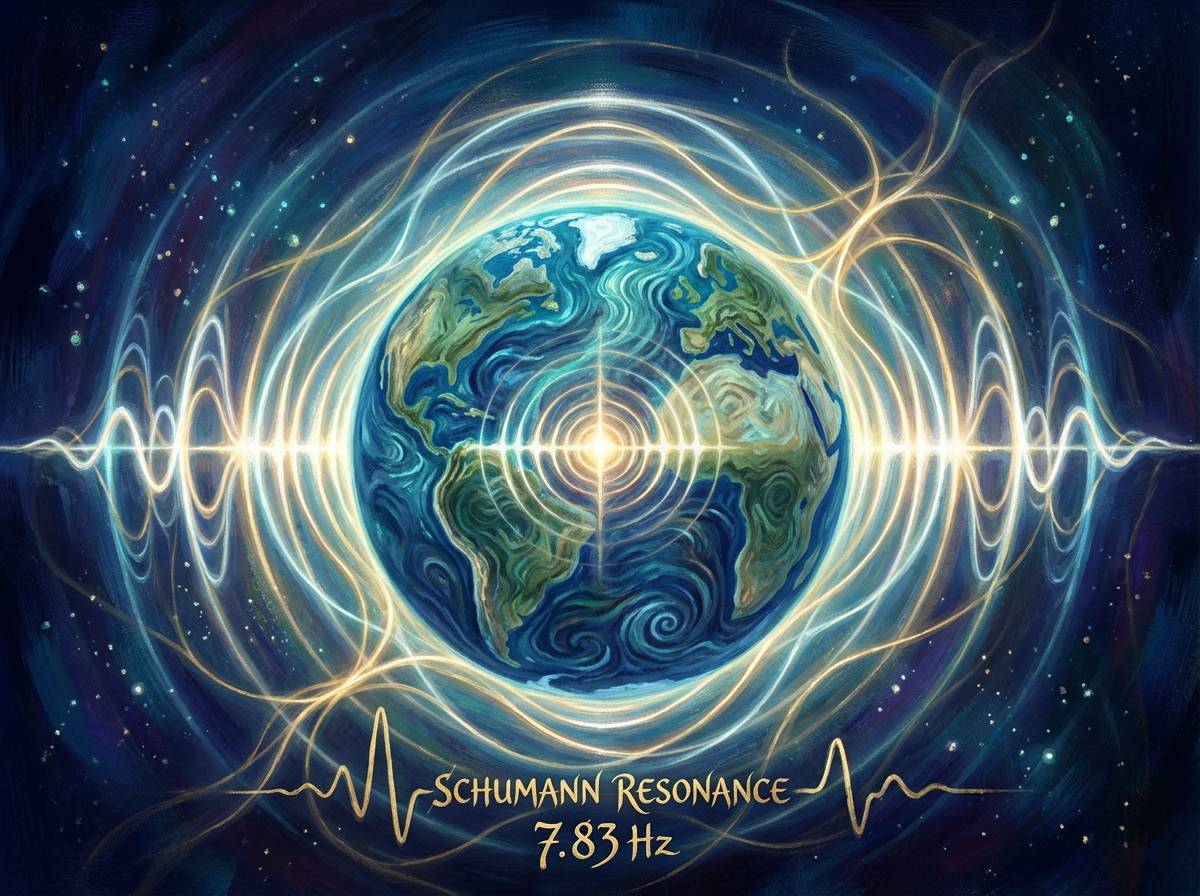
The Schumann resonances are natural electromagnetic resonant frequencies of the Earth–ionosphere cavity.
They are not “beamed in” from outside, not generated by human thought – they arise from the Earth–atmosphere system itself, especially from lightning.
3. The Earth–Ionosphere Cavity and Lightning
To really get what’s going on, I picture Earth and the ionosphere as two roughly spherical, conducting layers:
- The ground is electrically conductive.
- Around 60–100 km above, the ionosphere is a region where solar radiation has ionized atoms, making the air partially conductive.
- The space between them is mostly non-conducting air.
Together, these form a kind of spherical waveguide or resonant cavity. Electromagnetic waves can circle the planet within this shell. At particular frequencies, the waves reinforce each other, creating standing patterns.
What drives this system? Primarily lightning.
All around the world, lightning is striking constantly – dozens of flashes per second. Each lightning discharge sends a pulse of electromagnetic energy into the Earth–ionosphere cavity. Most of that energy just disperses, but at certain natural frequencies it “fits” the cavity and sets up standing waves that can be detected globally.
These standing waves show up as peaks in the very low end of the electromagnetic spectrum – the extremely low frequency (ELF) range. Those peaks are what we call the Schumann resonances.
4. The Main Schumann Frequencies
In practice, the Schumann spectrum has a series of resonant modes. The most commonly cited values are roughly:
- Fundamental mode: about 7.8 Hz
- Second mode: about 14 Hz
- Third mode: about 20 Hz
- Fourth mode: about 27 Hz
- Fifth mode: about 33 Hz
These aren’t perfectly sharp, exact numbers. Each mode is a broad peak, and the exact peak value can shift slightly depending on the ionosphere’s properties, global lightning distribution, time of day, season, and solar activity. But they cluster around those frequencies.
So when people say “the Schumann resonance is 7.83 Hz,” they’re really talking about just the strongest fundamental mode. The full reality is a spectrum of several resonances.
5. A Brief History: This Isn’t New
One misconception I hear a lot is that the Schumann resonance is some sort of brand-new discovery that suddenly changed in recent years. It actually has a long scientific history.
- In the late 19th and early 20th century, scientists already suspected that the upper atmosphere was conductive and that Earth plus this conducting layer could support global electromagnetic oscillations.
- Work on the ionosphere (once called the “Heaviside layer”) helped clarify that we really do have a conductive region high above the surface that can reflect and guide radio waves.
- In the 1950s, physicist Winfried Otto Schumann calculated the natural electromagnetic modes of the Earth–ionosphere cavity and predicted resonant frequencies in the 8 Hz range and its harmonics.
- Soon after, researchers began measuring these ELF resonances experimentally and clearly identifying their peaks in the spectrum.
- Since the 1960s, various observatories around the world have monitored Schumann resonances using sensitive coils and antennas, building up long-term data on how they vary.
So when people talk as if this is a totally new phenomenon that only “started changing in recent decades,” that doesn’t match the history or the data. The system has always been dynamic and “breathing.”
6. What Does It Mean That the Resonance “Varies”?
This is where metaphysical talk and scientific reality get tangled. Everyone agrees the Schumann resonances change over time. The question is how they change and what that means.
To me, there are two distinct properties people mix up:
- Frequency – where the peak is on the horizontal axis (in Hz).
- Amplitude (or power) – how strong or tall that peak is.
Most of the dramatic online posts about “Schumann going to 40 Hz!!” are actually confusing amplitude changes and other spectral features with a shift in the fundamental frequency itself.
6.1 Frequency Behavior
Long-term monitoring shows that the frequencies of the main modes stay close to their known values. The fundamental is still centered near that 7–8 Hz range, and harmonics are where we expect them to be. They wobble slightly with ionospheric conditions, but they do not shoot up into the tens of Hz and stay there.
So if someone claims that Earth’s “base frequency” has permanently jumped from 7.8 Hz to 13 Hz, or 40 Hz, that doesn’t line up with actual measurements.
6.2 Amplitude Behavior
Amplitude is a different story. That really does fluctuate – a lot. When lightning activity changes, when the ionosphere is affected by solar storms, or when seasonal patterns shift, the strength of the Schumann peaks can go up or down significantly.
On spectrograms, this shows up as:
- Brighter or more intense bands at the usual Schumann frequencies.
- Occasional “whiteout” or strong vertical bands when the site is detecting a lot of ELF energy.
- Sometimes dark strips when the instrument is offline or data is missing.
But again, these are changes in how loud the resonances are – not qualitative transformations of the frequencies themselves.
7. How Strong Are These Fields, Really?
Another question I ask myself is: even if the Schumann amplitudes change, are these signals strong enough to directly “mess with” the human mind in a big, obvious way?
Typical Schumann field strengths near the ground are very small:
- The alternating magnetic field of the fundamental mode is on the order of a few picotesla (trillionths of a tesla).
- The electric component is on the order of fractions of a millivolt per meter.
For comparison:
- Earth’s static geomagnetic field is tens of microtesla – millions of times stronger than the Schumann magnetic component.
- The fair-weather static electric field near the ground is on the order of hundreds of volts per meter, far larger than the Schumann ELF electric part.
So the Schumann resonances are not giant, overpowering waves slamming into us. They’re faint background oscillations riding on top of much stronger electromagnetic and static fields we live in all the time.
That doesn’t mean they’re irrelevant. It just means that if they influence biology, it’s likely in subtle, long-term, or finely tuned ways – not in the dramatic “flip a planetary switch and everyone acts crazy” sense.
8. What Science Says About ELF Fields, Brainwaves, and Biology
There’s a lot of research on extremely low frequency (ELF) electromagnetic fields and their effects on living systems. Most of it doesn’t focus specifically on Schumann-level fields, but on the broader ELF range.
A few interesting points that I keep in mind:
- The Schumann fundamental (~7.8 Hz) is in the same range as human alpha/theta brainwaves (roughly 4–13 Hz), which are associated with relaxed wakefulness and light meditation. That overlap is genuinely intriguing, but overlap in frequency doesn’t automatically mean strong biological coupling.
- Experiments with ELF fields at much higher intensities (often thousands or millions of times stronger than natural Schumann levels) show that they can alter neuronal activity, gene expression, or behavior in animals. But these are not the same field strengths we experience from natural Schumann resonances.
- Reviews suggest that Earth’s electromagnetic environment – including things like geomagnetic disturbances and possibly Schumann-band activity – might be linked in subtle ways to circadian rhythms, sleep quality, or certain health outcomes in small subsets of people. But the evidence is still mixed and not definitive.
To me, all of this adds up to a cautious “it might matter a little” rather than a confident “this is the main thing controlling our emotions and behavior.”
9. The Metaphysical Claims: “The Resonance Is Messing with Me”
Now I want to address the specific kind of statement I hear so often in metaphysical spaces:
“The increase of the resonance is messing with me.”
When someone says this, I try to separate out several layers:
- Their felt experience: they feel off – anxious, dizzy, emotional, exhausted, wired, or otherwise out of balance.
- The physical reality: the Schumann resonances may have higher amplitude than usual on that day, or they may just have seen a chart online that says so.
- The story: they’re connecting the first (feeling off) to the second (a chart or an idea) and concluding cause and effect.
Here’s how I respond internally:
- I absolutely believe their experience. If someone tells me they feel wrecked or raw, I take that seriously. Our bodies and emotions are real, and they don’t need permission from physics to matter.
- I also know that there is no strong scientific evidence that the normal variability of Schumann resonances, by itself, directly causes acute mood swings or physical symptoms at the level people often describe in daily life.
So I tend to treat “the resonance is messing with me” as a kind of energetic metaphor or symbolic language rather than a literal, measured cause.
If I had to put it into words, I might say:
“I accept that I feel off right now. I’m also aware that people, including me, like to tie those feelings to something cosmic or planetary. Schumann resonances do vary, but current science doesn’t really support the idea that these small changes directly hijack my mood. So I’ll treat ‘the resonance is messing with me’ more as an intuitive or poetic way to say ‘the energy feels weird,’ not as a literal diagnosis.”
10. “The Resonance Is Causing People to Act Crazy”
The second statement I often hear is stronger:
“The resonance is causing people to act crazy.”
Here I’m even more skeptical. On days when people feel the world is chaotic, there are many obvious reasons we can point to: social tension, economic stress, climate anxiety, online conflict, lack of sleep, unresolved trauma, and so on. Human behavior is being pulled in a dozen directions at once.
Attributing all of that to slight fluctuations in a faint ELF background field seems like a huge oversimplification. When I look at actual Schumann data versus, say, worldwide events, I don’t see clear, direct correlations that would justify saying “this is the cause of people acting out.”
So my personal view is:
- It’s understandable that people use Schumann resonance language to describe a sense of collective craziness.
- But as a literal physical claim – that Schumann variations are the main driver of human irrationality – I don’t find that credible with the evidence we have.
I’m more comfortable saying something like:
“Right now, human systems are under enormous pressure. That’s why people are acting unstable. If I want to use the Schumann resonance as a symbol for how the energetic atmosphere feels, I can – but I don’t pretend the physics itself proves this craziness.”
11. The “Time Is Speeding Up” Story
Another popular meme in metaphysical circles says something like:
- “The Schumann resonance used to be 7.83 Hz, but now it’s much higher.”
- “Because of that, 24 hours now feels like 16 hours – time is speeding up.”
The idea is that if Earth’s “frequency” goes up, then our subjective sense of time compresses. It’s a poetic idea, but it doesn’t match how timekeeping works.
We keep incredibly precise track of time using atomic clocks and measurements of Earth’s rotation. The actual length of a day does fluctuate slightly, but we’re talking about milliseconds, not hours. There is no evidence that days have shrunk to “16 energetic hours” in any physical sense.
If time feels faster to me personally (and it often does), that’s due to psychological and cultural factors, not a huge unseen jump in the Schumann resonance rewriting the clock.
12. Psychological and Social Feedback Loops
There’s another layer I can’t ignore: how stories affect perception.
Once a community internalizes a story like:
- “Schumann spikes make you tired, emotional, or reactive.”
- “Big white bands on the chart mean today is intense and chaotic.”
…it’s very easy for that to become self-reinforcing:
- People see a chart or a meme saying “huge spike today.”
- They start scanning their experience for signs that match that narrative.
- Every argument, weird mood, or difficult interaction gets attributed to the spike.
- Misses – calm days with high readings or chaotic days with ordinary readings – tend to be ignored.
That doesn’t mean anyone is faking or lying. It just shows how powerful expectation and meaning-making are. Our nervous systems are highly suggestible.
For me, it’s important to notice this pattern so I can ask myself:
“Am I genuinely picking up something subtle from the environment right now, or am I fitting my experience into a story because that’s the story my community repeats?”
13. How I Integrate Schumann Resonance into My Spiritual or Occult Practice
As someone interested in magick, occultism, and energy work, I don’t throw the Schumann idea out. I just place it in two different layers: the symbolic and the physical.
13.1 Symbolic Layer
On a symbolic or poetic level, I actually love the image of Earth having a subtle electromagnetic “heartbeat” in the ELF range. Lightning flashing constantly around the globe, feeding a background hum in the cavity between Earth and sky – that’s powerful imagery for meditation, ritual, or trance work.
In that mode, I might say:
“I’m dropping my awareness into the Earth–sky shell, letting my breath sync with the planet’s low hum. I imagine my own brainwaves entraining to this deep, global rhythm.”
I know I’m speaking metaphorically, in spiritual language. I don’t need to pretend that my words are a physics lecture. They’re a way of engaging my psyche with a real natural phenomenon in a creative, occult way.
13.2 Physical Layer
On the physical side, I keep a simpler, more sober picture:
- The Schumann resonances are natural standing waves in the Earth–ionosphere cavity, mostly driven by lightning.
- Their frequencies and amplitudes do vary – that’s normal – but the fundamental doesn’t suddenly leap to 40 Hz and stay there.
- Their field strength is very low compared to many other electromagnetic influences we’re constantly immersed in.
- Any direct effects on human behavior are likely subtle, if they exist at all, and they’re certainly not well established as a primary cause of social chaos.
When I speak to others, I try to be clear about which layer I’m in: am I using Schumann as mythic language, or am I talking about scientific data?
14. Phrases I Use When People Bring This Up
Because I run into these conversations a lot, I’ve found it helpful to have a few ready-made ways of responding that respect people’s feelings but don’t give up on accuracy.
14.1 When Someone Says “The Increase of Resonance Is Messing with Me”
I might say something like:
“I believe you feel off – I’ve had days like that too. The Schumann resonances are real and they do vary, mainly because of lightning and changes in the ionosphere. But from what I’ve read, the normal ups and downs of those frequencies aren’t known to directly scramble our minds. I think of Schumann more as a subtle background rhythm that I can use symbolically in my practice, not as the main cause of my mood.”
14.2 When Someone Says “The Resonance Is Making People Act Crazy”
I might respond:
“It definitely feels like people are under pressure right now. But the Schumann resonances themselves are extremely faint and quite stable in frequency. They’ve been there for as long as we’ve had lightning. The idea that they’ve suddenly cranked up and are making people act crazy doesn’t really fit the data. I think most of the ‘craziness’ is more about human systems and stress than about a subtle electromagnetic background.”
14.3 When I Want to Bridge Both Worlds Gently
If I want to honor someone’s spiritual language but still be honest, I might say:
“I like using the Schumann resonance as a symbol for Earth’s subtle heartbeat. It gives me a way to imagine connection between my body and the planet. Physically, though, it’s a set of natural electromagnetic frequencies that fluctuate within a normal range. So if I feel destabilized, I’ll acknowledge that and maybe even look at the EM ‘weather,’ but I won’t put all the blame on the Schumann chart. It’s one ingredient in a much bigger recipe.”
15. My Bottom Line
After looking at the physics, the history, the biology, and the kinds of stories we tell in metaphysical spaces, my personal bottom line is this:
- The Schumann resonances are real, natural electromagnetic phenomena of the Earth–ionosphere cavity, driven by lightning.
- They have a main mode near 7.8 Hz and several harmonics, and these frequencies and amplitudes do vary – but within a limited range.
- They are not suddenly “spiking to 40 Hz” in the sense of changing the fundamental planetary frequency. Most such claims come from misunderstandings or misinterpretations of spectral charts.
- Natural Schumann fields are very weak compared to other electromagnetic influences; any direct, short-term behavioral effects on humans are at best subtle and not well established.
- The statements “the increase of resonance is messing with me” and “the resonance is causing people to act crazy” are best understood as metaphorical or symbolic rather than literal diagnoses based on current science.
- As an occult practitioner, I can still meaningfully use the idea of a planetary hum or “Earth heartbeat” in ritual and meditation – as long as I’m honest with myself about which parts are data and which parts are spiritual imagination.
For me, that honesty doesn’t kill the magic. It deepens it. I can let the real, measured Schumann resonances inspire my symbolism and practice, while recognizing that the phrase “the resonance is messing with me” is more about how I feel and how I choose to interpret that feeling than about a faint ELF wave forcing my behavior.