


Popular Articles
- Witches Wheel Sigil Generator
- Interdimensional Perspectives on the Enochian Communications
- The Observer Effect
- Faith-Based Medical Neglect
- Quantum Nexus in the Unicursal Hexagram
- Exploring Past Lives, DNA Memories, Soul and Quantum Connections
- Intersections of Quantum Mechanics and Magick
- Cuneiform Glyph Generator
- Witches Do Exist: A Modern Exploration
- Exploring Plasma-Magnetic Dynamics
Technomagickal Archive
Explore an expanding interconnected research library of occult, esoteric, historical, symbolic, scientific, and philosophical correspondences. Search across traditions, concepts, materials, divination systems, cosmology, physics, alchemy, dreams, numerology, and other areas of Technomagickal study. This is not AI driven but based on a locally stored library that we are always expanding on.
Enter the Technomagickal Archive ↗Technology, Fear, and Change
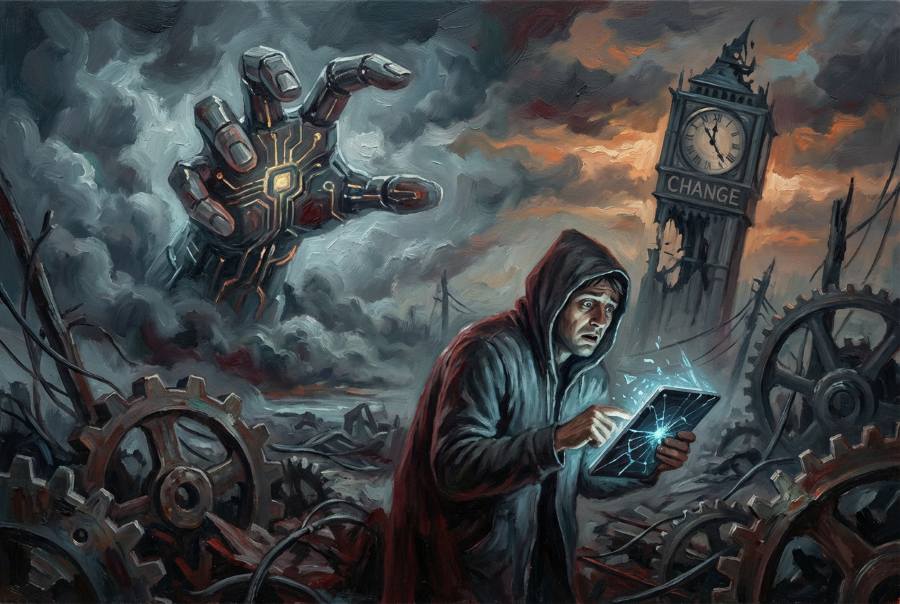
Technology, Fear, and Change: A First-Person Reflection
I argue that every major leap in technology, science, art, and medicine follows a familiar pattern: excitement from some, deep anxiety from others, and then, over time, a slow normalization where yesterday’s “dangerous innovation” becomes today’s ordinary tool. I have watched this cycle unfold in my own lifetime with computers, the internet, and now artificial intelligence. When I look back further into history—especially into the 16th and 17th centuries—I see the same rhythm of fear, resistance, gradual acceptance, and eventual dependence.
In this paper, I reflect on how technological shifts have been received, how I personally use AI today, and why I believe regulation should precede, not follow, massive changes. I also compare modern attitudes to earlier reactions to innovation, to show that the fears we hear now are not new, even though the tools are.
1. The Recurring Chorus of Fear
Every time some new invention appears, a chorus of familiar objections seems to rise almost on cue. I hear phrases like:
- “It will take jobs.”
- “It will make people lazy or stupid.”
- “Machines will take over.”
- “This will destroy the environment.”
- “It will ruin real art.”
These reactions show up now around AI, but they were also used about computers, industrial machinery, even earlier about the printing press and new scientific instruments. The details change—factory machines replacing weavers, robots replacing line workers, algorithms replacing analysts—but the emotional script remains recognizable: fear of loss, fear of dehumanization, and fear of losing control.
From my point of view, the fear itself is understandable. When a technology promises to automate or accelerate tasks, people see not just the tool, but the implied reshaping of their daily lives. If I put myself in the position of a worker who has mastered a craft over decades, and someone installs a machine that can replicate it faster and cheaper, I see why that would feel like an existential threat. At the same time, the historical record, and my own experience, suggest that while disruption is real, so are new opportunities that emerge around and because of the new tools.
2. A Brief Look Back: The 16th and 17th Centuries
To understand how old this pattern is, I look back to the 16th and 17th centuries, a period often associated with the Scientific Revolution and early modernity. This era witnessed dramatic shifts:
- The printing press, developed earlier, became widely distributed, enabling a rapid spread of books, pamphlets, and scientific works.
- New instruments such as the telescope and microscope opened up the sky and the micro-world to observation.
- Advances in navigation, cartography, and shipbuilding made global exploration and trade possible on a new scale.
- In medicine and anatomy, physicians started to challenge ancient authorities and rely more on experiment and direct observation.
All of these changes were controversial in their own way. Printed books spread not only knowledge but also religious and political dissent. Some authorities feared that allowing ordinary people access to texts would lead to confusion, heresy, and social disorder. New astronomical findings, like those supporting a sun-centered universe, threatened established theological views and were sometimes treated as dangerous challenges to the social and religious order.
Medical innovations faced their own anxieties. The idea of dissecting human bodies to learn anatomy was shocking and sometimes seen as morally suspect. Early experiments in circulation and physiology challenged centuries of accepted doctrine. Many people trusted traditional remedies and religious explanations for disease, and they might have seen new methods as risky or impious.
When I compare that period to today, I recognize the same emotional undercurrent. Instead of “AI will take jobs,” earlier critics might have said, “Books will corrupt the masses” or “New instruments will undermine proper faith.” The tools are different, but the worry that knowledge and power are shifting too quickly—and into the wrong hands—is consistent.
3. From Mainframes to Dial-Up: My First Encounter with Digital Change
In my own lifetime, I have watched one particular technological arc: the rise of personal computers and the internet. When computers first entered everyday conversation, they were prohibitively expensive and physically large. Only an elite few individuals or institutions could afford them. For many, computers were mysterious machines behind closed doors, controlled by experts.
When I first encountered computers more directly, the experience felt limited by today’s standards. The internet connection was dial-up, painfully slow and noisy as it connected through a phone line. It felt only a step above using a bulletin board system (BBS)—text-heavy, mostly static, and fairly niche. At that time, few people imagined streaming video, cloud computing, or AI systems woven into almost every digital service.
Yet I remember that even in those days, there were worries: computers would wipe out certain jobs, especially clerical roles; children would stop reading books; people would lose social skills; the virtual world would replace the real one. Some of these concerns were partly justified—we do see changes in how people socialize and communicate—but at the same time, whole new industries formed around programming, web design, online commerce, digital art, and more.
I was, and still am, fascinated by how quickly the extraordinary becomes ordinary. The idea of being “online” used to be a special activity; now it is the default state. And this shift happened within my own lifetime, right in front of me.
4. Games, Software, and AI: From Play to Infrastructure
Today, I see AI embedded in almost everything digital. Many games and software products include some form of AI, whether in enemy behavior, procedural content generation, recommendation systems, or adaptive difficulty. Some games even serve as testing grounds for AI development, providing complex environments where algorithms can learn strategies, coordination, and decision-making.
To me, this is a striking example of how a technology first appears as an enhancement, a novelty layer added onto existing systems. Over time, that “extra” layer becomes part of the infrastructure. At first, AI in games might feel like a feature. Eventually, we begin to expect that level of dynamic behavior and personalization. When it’s missing, the product feels outdated.
There are worries here too. People fear that generative algorithms will weaken human creativity, that students will stop learning basic skills if AI can summarize or write for them, that recommendation engines will narrow our tastes instead of broadening them. These concerns are not groundless, but they also overlook how people often adapt. Tools influence culture, but culture also pushes back, reinterprets, and reshapes how tools are used.
In my view, AI in games and software illustrates the blend of play and research that defines our era. What looks like entertainment is sometimes also a sophisticated laboratory for machine learning. The line between “toy” and “tool” continues to blur.
5. How I Use AI: Augmentation, Not Replacement
Despite all this, I do not rely on AI for everything. At work, I do not hand over my core responsibilities to a machine, but I use AI heavily to increase my productivity and to assist with analytical tasks. The contrast in efficiency can be dramatic.
One concrete example from my own experience is a recurring project that involves sifting through a large dataset. In the past, this exercise would consume roughly three full working days. I had to clean the data manually, perform calculations, look for patterns, and then summarize the findings in a format that others could understand. It was careful, tiring work, and although I learned a lot from doing it, it was also repetitive.
Now, I can complete that same project in about two minutes using AI tools and modern software. The system helps me quickly structure the data, perform complex queries, and generate initial summaries. I still review the output carefully and interpret the results myself, but the machine has taken over the most mechanical parts of the process.
For me, this is the ideal way to use AI: as an amplifier of human effort, not a substitute for human judgment. I do not feel that I have become “dumber” because the machine does the preliminary calculations. Instead, I have freed up energy and time to focus on asking better questions and making more thoughtful decisions about what the numbers mean.
6. The Paradox of Protest: Fear, Control, and Scapegoats
Given all these benefits, I still see people strongly protesting new technologies. Some fear job loss. Others fear erosion of privacy, manipulation by algorithms, or environmental damage from energy-hungry systems. These worries have real substance. Massive data centers, for example, do consume significant energy, and automation can displace workers in certain sectors.
However, I also notice another layer beneath the rational arguments: a deep fear of change itself. In many debates, especially online, the tone becomes moralistic and absolutist. New tools are framed as either salvation or damnation, and people begin to look for villains—corporations, technologists, governments—to blame or even demonize.
Historically, this instinct has sometimes taken on extreme forms. In the 16th and 17th centuries, when people could not explain sudden social, economic, or climatic changes, some societies turned to witch hunts or accusations of heresy. Instead of questioning underlying structures or accepting that change was part of a larger transformation, they targeted individuals as symbolic culprits.
In a much less literal sense, I see echoes of that mentality today. Instead of engaging deeply with how to guide AI, some critics seem more interested in condemning it outright or vilifying anyone who works on it. It feels, at times, like a modern search for “heretics” to blame, rather than a practical effort to make the world better with, and not just in spite of, new technology.
7. The Corporate Advantage and Public “Clean-Up”
One area where I share the critics’ frustration is the imbalance between who benefits first and who pays the hidden costs. Corporations often gain from new technologies long before regulations are updated. They can monetize data, scale automated systems, and exploit new efficiencies quickly. Meanwhile, the general public is left to play “clean-up,” dealing with issues such as job displacement, privacy violations, environmental impacts, and mental health effects from badly designed digital environments.
I see this dynamic clearly in social media, data collection, and now AI. Powerful systems are deployed into daily life at high speed, and only when damage becomes obvious do serious discussions about rules and limits begin. By then, habits are formed, markets are established, and reversing course is difficult.
From my perspective, this is backwards. With all major technological changes, there should be regulatory frameworks considered and, where necessary, implemented before deployment at large scale—not slapped on afterward as a reaction. This does not mean slowing innovation to a halt, but it does mean treating large-scale technologies the way we treat other powerful systems: like medicine, infrastructure, or transportation, where safety and responsibility are built in from the start.
8. Evolution: Change as a Constant, Not a Glitch
When I zoom out, I see that change is not an exception; it is the rule. Technological, scientific, artistic, and medical evolution is continuous. What we call “progress” is often uneven and messy, with gains in some areas and losses or disruptions in others. But stagnation is not really an option. Even if one society tries to halt innovation, others will continue, and their advances will eventually ripple outward.
I think of this process as a kind of social and technological evolution. Tools that solve real problems, or open new possibilities, tend to spread, even if they initially face resistance. Over time, they are integrated into the fabric of life. We barely notice them as “technology” anymore—electricity, indoor plumbing, printed books, search engines. They become part of the invisible environment.
In that sense, protest alone cannot stop change. At best, it can slow it down or redirect it. The more productive approach, in my view, is to accept that evolution is inevitable and to focus on shaping it. That means asking: how do we design systems that are fair, transparent, sustainable, and humane? How do we ensure that the benefits are not hoarded by a small group while the risks are socialized?
9. Fear Versus Responsibility
I do not dismiss the people who protest new technologies. Their anxiety often points toward real issues—loss of livelihoods, erosion of human connection, environmental strain. But fear on its own is a poor guide. It tends to push people toward extremes: total rejection or blind acceptance.
What I advocate instead is responsibility. Accept that new tools will arrive, as they always have. Recognize that they can be misused or deployed without proper safeguards. Insist on regulations, ethical standards, and public scrutiny before systems are scaled up. Demand that corporations, governments, and developers are held accountable for the impacts of what they release.
What I resist is the attitude that every new technology is automatically evil, or that the only honest response is to metaphorically “burn the heretics”—those who design, study, or use these tools. That mindset, to me, is a dead end. It repeats the worst parts of our past without offering a real solution.
10. Conclusion: Being Part of the Change
Looking from the 16th and 17th centuries to the present, I see the same cycle repeating: innovation, fear, resistance, gradual adoption, and eventual normalization. Printed books, telescopes, anatomical studies, steam engines, computers, the internet, and now AI have all been met with some version of “This will ruin everything.” Yet here we are, living in a world shaped by all of those technologies, many of which we now consider essential.
In my own life, I have moved from dial-up connections and rare home computers to a world where software and game environments include AI as a matter of course. I use AI at work not as a crutch but as an amplifier, turning a three-day task into a two-minute one and freeing my mind for more complex questions. I am not blind to the dangers or naive about the unequal distribution of benefits. That is exactly why I believe regulations should be part of the conversation from the beginning, not bolted on after the damage is done.
Change is inevitable; that is what evolution means in a technological and social sense. The real choice I face is whether I will be shaped passively by these changes or participate in shaping them. I choose the latter. Instead of fearing new tools as monsters that will take over, or searching for heretics to blame, I want to engage with them critically and constructively—to insist on responsibility, to push for fairness, and to help turn disruption into genuine improvement.
In other words, I accept that I am part of the change. The question is not whether change will come, but what kind of world we will build with it.