

Popular Articles
- Witches Wheel Sigil Generator
- Interdimensional Perspectives on the Enochian Communications
- The Observer Effect
- Faith-Based Medical Neglect
- Quantum Nexus in the Unicursal Hexagram
- Exploring Past Lives, DNA Memories, Soul and Quantum Connections
- Intersections of Quantum Mechanics and Magick
- Cuneiform Glyph Generator
- Witches Do Exist: A Modern Exploration
- Exploring Plasma-Magnetic Dynamics
Technomagickal Archive
Explore an expanding interconnected research library of occult, esoteric, historical, symbolic, scientific, and philosophical correspondences. Search across traditions, concepts, materials, divination systems, cosmology, physics, alchemy, dreams, numerology, and other areas of Technomagickal study. This is not AI driven but based on a locally stored library that we are always expanding on.
Enter the Technomagickal Archive ↗“Trending” Spirituality vs. Actual Inquiry
How I See Leftover Dogma in New Age and Occult Circles
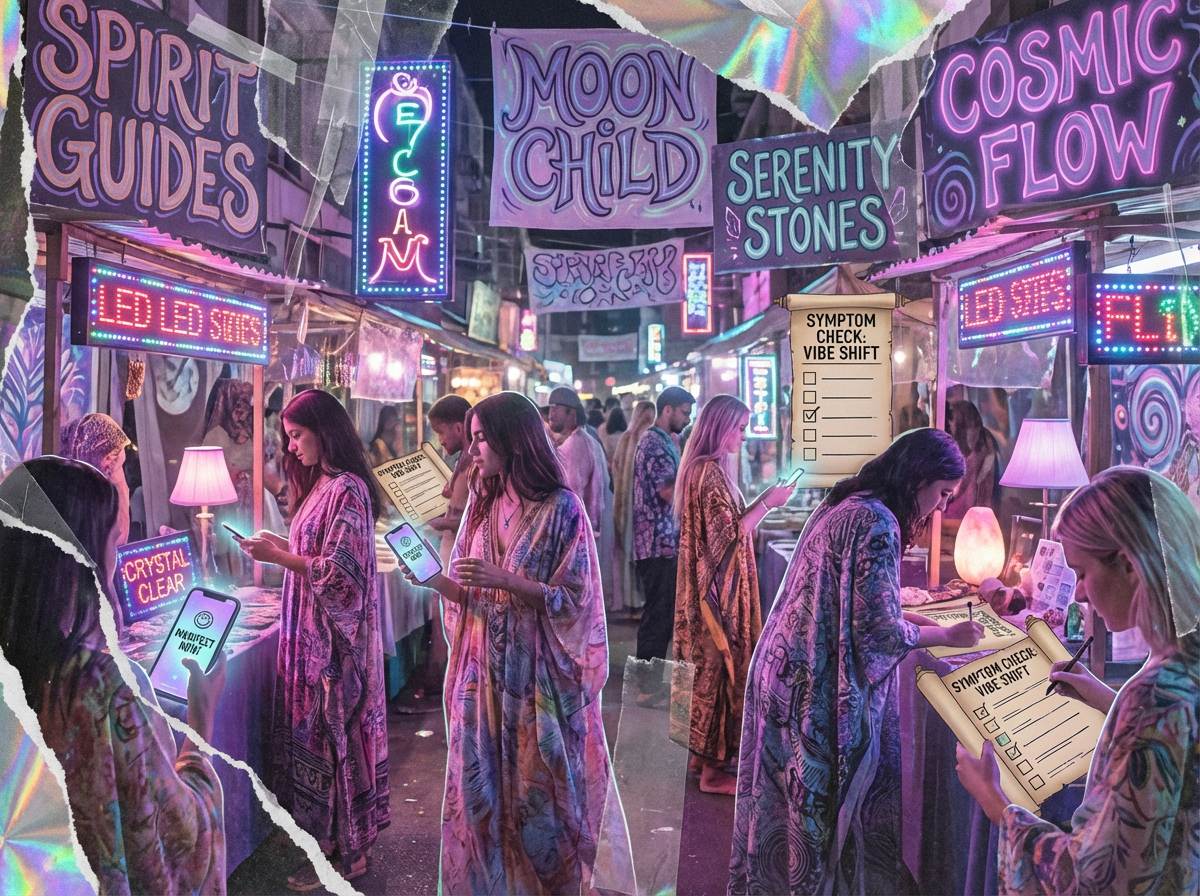
When I look around at a lot of metaphysical, New Age, and even occult research spaces today, I keep seeing the same pattern: people following trends instead of doing real inquiry. It shows up as “crystal of the week,” viral manifestation hacks, checklist-style “ascension symptoms,” and suddenly-everywhere spirit names.
The language is different from old religious dogma, but the structure feels eerily familiar to me: authority, obedience, and the subtle message, “Don’t think too hard, just accept.”
I’m not saying this as someone standing outside throwing stones. I’m inside these worlds. I practice magick. I study occult history. I’ve meditated, cast circles, experimented with sigils, and read grimoires late into the night. I’ve also watched how easily these practices get turned into aesthetic products and social-media-ready identities.
For a long time, I couldn’t quite name why this bothered me so much. Eventually I realized: a lot of us claim we’ve “left religion,” but we haven’t actually deprogrammed the habits of being controlled. We’ve just swapped one set of symbols and authorities for another.
I’m not pretending to be a neutral observer; I’m admitting my own involvement. I want to walk through how I see trend-following showing up in metaphysical and occult spaces, why it matters, and what “facts” could even mean in work that deals with mystery, symbolism, and subjective experience.
1. What I Mean by “Trends” Instead of Facts
When I say people are following trends, I’m not just complaining about popular interests. Humans have always had fads and fashions. I’m pointing at something deeper: beliefs and practices being adopted purely because they’re fashionable, emotionally satisfying, and constantly repeated — while evidence, nuance, and context are largely ignored.
In metaphysical and New Age circles, I see things like:
- A certain crystal suddenly becomes the cure-all: retrogrades, trauma, money problems, spiritual awakening — you name it, this one stone supposedly handles it.
- Concepts like “twin flames,” “starseeds,” or specific archangels rise and fall in popularity depending on which influencer is talking about them that month.
- Long posts about “DNA upgrades” or “5D shifts” appear with no clear definitions, no references, and no way to test any part of the claim.
- Complex astrological techniques are flattened into quick social-media bites where three lines of text supposedly describe your entire destiny.
In occult research circles, there’s a more bookish version of the same pattern:
- Everyone suddenly becomes obsessed with one grimoire or one particular spirit, because a popular author or magician brought it into the spotlight.
- People quote secondary sources about historical magic and never bother to check the actual manuscripts, translations, or scholarly debates.
- “Occult history facts” get repeated that are really just older myths, misreadings, or creative inventions that hardened into dogma over time.
None of this would bother me if these things were treated as stories or experiments — “Here’s something that helped me; try it and see what happens.” But that’s not how it’s usually framed. It often turns into implied truth, even when it contradicts basic evidence or when different teachers say completely different things.
That’s where the word “facts” matters to me, even in metaphysical and occult contexts.
2. What “Facts” Can Mean in a Metaphysical Context
Obviously, not everything in magick, energy work, or spirituality can be measured with current instruments or squeezed into a randomized controlled trial. If I demanded that, I’d basically be shutting down the entire occult project.
So when I talk about “facts,” I’m not pretending that everything has to be a lab result. I’m talking about honest contact with reality, wherever I can reach it. For me, that includes:
- Basic physical reality. If someone claims a crystal cures a specific physical disease, that’s not a purely spiritual question — that’s a medical one. We do have decades of research on many illnesses. Ignoring that and telling people to skip treatment and “just use this stone” is not spiritual; it’s dangerous.
- Consistent experiential patterns. When I work with a sigil, a spirit, or a ritual in a specific way and keep a detailed record, I can see over time whether it actually seems to correlate with changes in my life or psyche. It’s not perfect proof, but it’s better than believing something just because a tradition says so.
- Historical facts and context. Where a text comes from, how old it is, which culture produced it, and how it has changed over time — these are knowable things. Modern scholarship has untangled plenty of romantic stories about “ancient” wisdom that turned out to be surprisingly recent.
- Psychology and cognitive science. We have research on confirmation bias, pattern perception, and how people interpret randomness. Whether I like it or not, those findings apply directly to divination, synchronicity, and magical thinking. I can’t just pretend I’m immune to how my own brain works.
To me, “facts” in this sense are anchors. They don’t explain everything, but they keep me from drifting too far into fantasy — the kind of fantasy that feels empowering for a while but quietly disconnects me from reality.
3. Leftover Dogma Wearing New Clothes
A big realization for me was that dogma isn’t just about doctrine; it’s about structure.
In the religions many of us were raised in, the structure often looked something like this:
- A text or leader declares truth.
- Questioning that truth is framed as dangerous, sinful, or ego-driven.
- Belonging depends on accepting that truth.
- Dissent gets labeled as rebellion, error, or corruption.
Now I look at how a lot of spiritual trends function and I see the same skeleton underneath:
- A charismatic teacher, influencer, or channeler announces a new revelation: a portal date, an energy wave, a “download” about how reality really works.
- To question it is framed as “being stuck in 3D,” being “unawakened,” “low vibration,” or “too logical.”
- Belonging in the online community depends on enthusiastically affirming that you “feel the shift” and sharing the same language and memes.
- Those who ask for evidence or nuance are subtly shamed or pushed to the margins.
Same structure. Different words. The mechanism is still external authority plus social pressure, used to discourage real questioning.
I see a similar pattern in occult subcultures that claim to be about radical personal freedom but quietly enforce their own dogmas:
- The idea that “real magicians” must always stay in the light, avoid anything messy or shadowy, and follow the exact rules laid out in grimoires as if any personal adaptation or experimentation is automatically wrong.
- The insistence that certain lineages or initiations make you inherently superior to everyone else, as if spiritual hierarchy were the same thing as spiritual depth.
- The attitude that anything “too psychological” somehow makes your magic weak or fake, as if exploring symbolism and the unconscious were a betrayal of “serious” occult work.
The irony hits me hard: we say we’ve broken free from dogma and control, but often we’ve just put on a different costume — one made of occult symbols, angel names, planetary seals, or New Age buzzwords instead of the old religious ones.
4. Algorithms, Echo Chambers, and the Amplification of Trends
The old dogmas at least spread slowly. You had to publish books, hold meetings, persuade institutions. Now, a half-baked idea can go from one person’s imagination to millions of screens in a single day.
When I scroll through spiritual content online, I can feel the algorithms shaping my perception:
- Because I like occult or mystical content, the platform keeps feeding me more and more of it, often choosing whatever is most extreme, dramatic, or emotionally charged.
- Bold claims — “This ritual works 100% of the time,” “This portal will permanently change your DNA,” “This lightworking technique guarantees abundance” — get more engagement than careful, nuanced perspectives.
- Content that questions or complicates the story spreads more slowly, not because it’s wrong, but because it’s less exciting and less shareable.
From the inside of that bubble, it can look like there is universal consensus: “Everyone I follow says this portal is real,” or “All my favorite readers agree this new trend is the key to ascension.” But that’s more about the design of the feed than about the nature of reality.
For me, this means I have to be honest about how my perception is being steered. Repetition is not the same thing as truth. A thousand similar posts don’t magically turn a shaky idea into a solid one.
5. Confirmation Bias and Intuition: My Brain’s Double-Edged Sword
One of the most useful — and uncomfortable — things I ever learned about is confirmation bias. That’s the tendency to search for, remember, and interpret information in ways that support what I already believe.
I notice this bias in my magical and spiritual life all the time:
- If I pull a tarot card that vaguely matches my situation, I remember the “hits” and quietly forget the spreads that didn’t resonate.
- If I do a spell for money and later get a small unexpected refund, I rush to connect those dots and ignore all the workings that produced no obvious external results.
- If I believe a certain deity, angel, or spirit is guiding me, I interpret coincidences as proof of that guidance while brushing off anything that would challenge the story.
Research suggests that people who strongly believe in the paranormal often rely more on intuitive thinking, see patterns easily, and may show more confirmation bias in certain tasks. I don’t treat that as an insult. I treat it as a warning label on my own mind.
My brain is very good at weaving meaning, and that’s part of why I’m drawn to magick and symbolism in the first place. But the same ability that lets me see deep connections can also trick me into seeing certainty where there is only possibility.
For me, the response isn’t to shut down intuition. It’s to balance it with a willingness to ask, “What else might this mean?” and “What evidence would I accept that my current belief might be wrong?”
6. How Trend-Following Shows Up in Occult Research
In occult study circles, the trend-following sometimes wears more serious clothing, but it’s still there.
I see patterns like:
- Treating one famous author or order as the final word on everything, even when newer research has challenged or corrected many of their claims.
- Forming communities around one system — one style of astrology, one ceremonial tradition, one channeled text — and repeating its teachings as unshakeable truths.
- Hyping “ancient” documents or rituals that, under basic inspection, turn out to be quite modern, while still marketing them as timeless secrets.
When I actually look at the history of esoteric movements, I see that this has been happening for a long time. Different eras created their own mythologies about lost continents, secret masters, universal laws, and unbroken lineages. Some of that was poetic or symbolic, but over time those stories often solidified into literal belief.
Modern scholarship has untangled many of these narratives, showing where texts were edited, where sources were misread, and where authors were simply making creative leaps. Ignoring that work in favor of a romantic myth about “pure original wisdom” doesn’t make my practice more authentic. It just makes it more fragile.
I’m not saying history has to crush mystery. I’m saying that when I use historical sources, I have a responsibility to know at least roughly what I’m working with. Otherwise I’m just building dogma on top of dogma.
7. The Seduction of Control
Underneath all of this — New Age trends, strict light-only grimoires, ceremonial pecking orders, algorithm-driven spiritual content — I feel a deeper craving: control.
A lot of us come from families, cultures, or religions where control was explicit: rules about what to believe, who to love, what to hope for, what to fear. When we step into metaphysical or occult spaces, we say we’re seeking freedom. But the old fear of chaos doesn’t vanish overnight.
Trendy spiritual beliefs often promise:
- Predictability: “If you say this affirmation for 21 days, you will manifest X.”
- Moral certainty: “High-vibration people behave like this; low-vibration people behave like that.”
- Cosmic order: “Everything happens for a precise spiritual reason. If something bad happens, you must have attracted it.”
Those ideas can feel soothing, especially if I’ve felt powerless. But they can slide into blame and self-gaslighting: if the ritual doesn’t work, maybe I wasn’t pure enough; if my life is messy, maybe I’m secretly doing it wrong.
Occult dogmas offer a similar seduction:
- If I memorize enough correspondences and follow the books perfectly, I might feel like I can bend reality to my will.
- If I belong to a respected lineage, I might feel chosen, superior, or safe in a chaotic world.
I value technique and lineage; they can be powerful anchors. But when I treat them as a guarantee of control, I’m back in the same prison I thought I left — just with a different uniform.
8. How I Try to Deprogram Myself
I don’t see myself as above any of this. I’m deeply susceptible to trends, aesthetics, and the temptation of ready-made answers. So I’ve had to build some personal practices to push back.
8.1. Keeping a Magical and Spiritual Journal
I treat my journal almost like a lab notebook. When I try a ritual, meditation, or technique, I write down:
- What I did, in detail.
- What I expected or hoped for.
- What actually happened in the following days or weeks.
- How I felt about the results, separately from the external events.
Over time, this lets me see patterns: which methods seem to correlate with meaningful change, and which mostly create a temporary buzz with little lasting impact.
8.2. Looking for Disconfirming Evidence
To counter my own confirmation bias, I sometimes deliberately try to prove myself wrong. For example:
- If I believe a certain planetary day is crucial, I’ll test similar workings on other days and compare outcomes.
- If I’m sure a certain style of spell “never fails,” I’ll check my journal to see if that’s really true or just a feeling.
This doesn’t turn my practice into a cold experiment, but it does add a layer of honesty. It keeps me from inflating my results and then building a whole belief system on those exaggerations.
8.3. Cross-Referencing Spiritual Claims with What’s Known
When I hear concrete claims — about health, brain chemistry, specific physical effects — I check what’s actually known in those fields. If a spiritual idea crosses into territory where science has something to say, I listen, even if I don’t always like what I hear.
For me, this isn’t about kneeling to materialism. It’s about respecting reality enough not to make things up, especially when people’s safety is on the line.
8.4. Exposing Myself to Multiple Perspectives
Instead of living in one spiritual echo chamber, I:
- Read practitioners from different traditions, especially those who disagree with each other.
- Pay attention to scholars and skeptics who challenge popular narratives.
- Listen to people who left certain spiritual scenes and explain why.
Hearing those voices helps me see my own blind spots. It reminds me that no single system has a monopoly on truth, and that sincere, intelligent people can come to very different conclusions.
8.5. Treating Beliefs as Tools, Not Cages
One of the biggest shifts for me has been seeing beliefs as tools I can pick up and set down, rather than cages I’m locked inside. When I notice I’m clinging to a belief like it’s the only way the universe can be, I try to loosen my grip and say:
“Right now, this belief is useful to me. It might not be the final word.”
That small bit of distance makes it easier to update my worldview when reality doesn’t match my expectations.
9. Red Flags I Watch for in Spiritual and Occult Spaces
Because I’ve spent time deprogramming myself, certain patterns now jump out at me as red flags:
- No room for “I don’t know.” If every question has a neat, confident answer, I get suspicious. Reality is more complex than that.
- Shaming doubt or critical thought. When curiosity gets labeled as “low vibration,” “ego,” or “lack of faith,” I see dogma, not wisdom.
- Infallible authorities. If a teacher or influencer is never allowed to be wrong or change their mind, that’s a cult of personality, not a path of growth.
- Spiritual bypassing of real-world issues. When phrases like “everything is an illusion” or “you attracted this” are used to shut down conversations about pain, injustice, or trauma, I back away.
- Unfalsifiable claims. If every failed prediction is explained away with “timelines shifted” and every criticism is “you’re not ready yet,” then nothing is really at risk and nothing can ever be tested.
- Merch-driven enlightenment. I don’t mind people charging for their work, but when enlightenment always seems to require the next course, the next attunement, the next upgrade, I pay attention to the underlying incentives.
These signs don’t prove a community is harmful, but they tell me to stay awake and keep my discernment sharp.
10. A Healthier Relationship to Mystery (for Me)
After talking so much about facts, bias, and dogma, it might sound like I’m trying to rationalize magic out of existence. I’m not. I value mystery deeply. I don’t think everything important can be reduced to measurements and charts.
What I want is a healthier relationship to mystery — one where I can be in awe without surrendering my ability to think.
For me, that looks like:
- Wonder with boundaries. I allow myself to be moved by synchronicities, dreams, and encounters in ritual. I also keep track of them, so I can see the difference between genuine patterns and random noise.
- Humility. I remind myself regularly that I might be wrong, that other serious practitioners see things differently, and that the universe has no obligation to match my favorite cosmology.
- Embodiment. I check how beliefs affect my body and relationships. If a trend makes me constantly anxious, paranoid, or checked out from daily life, I question it — no matter how enlightened it’s supposed to be.
- Ethics rooted in reality. I care about how my choices affect actual people and ecosystems, not just how they feel energetically in my private experience.
In other words, I let both my rational and intuitive sides have a seat at the table. I don’t treat one as the enemy of the other. That balance feels more like real magic to me than any “instant manifestation” trick.
11. From Control to Collaboration
The more I examine these dynamics, the more I feel that the real shift isn’t “science versus spirituality” or “skeptic versus believer.” It’s control versus collaboration.
- Control says: “If I find the right system and follow it exactly, I will always be safe, always be right, and always get what I want.”
- Collaboration says: “I am in dialogue with a reality that’s bigger than me. I can influence some things, but I also listen, adapt, and accept uncertainty.”
When I fall into trend-following, what I’m often really seeking is control — the comfort of believing someone else already has all the answers and I just have to sign up. When I practice genuine inquiry, I’m choosing collaboration: a relationship with the unknown that includes curiosity, testing, learning, and changing.
I doubt I’ll ever completely escape my conditioning. The leftover dogmas of my upbringing and my culture will probably keep whispering in my ear. But I can keep noticing when I’m handing my power away to trends, and I can keep gently taking it back.
Because if there’s one principle I come back to again and again, it’s this:
Any path that demands I stop thinking for myself is not liberation. It’s just control in prettier clothes.
And whatever else I may believe or experiment with, I know I’m not here to worship control — no matter how metaphysical the branding might be.