


Popular Articles
- Witches Wheel Sigil Generator
- Interdimensional Perspectives on the Enochian Communications
- The Observer Effect
- Faith-Based Medical Neglect
- Quantum Nexus in the Unicursal Hexagram
- Exploring Past Lives, DNA Memories, Soul and Quantum Connections
- Intersections of Quantum Mechanics and Magick
- Cuneiform Glyph Generator
- Witches Do Exist: A Modern Exploration
- Exploring Plasma-Magnetic Dynamics
Technomagickal Archive
Explore an expanding interconnected research library of occult, esoteric, historical, symbolic, scientific, and philosophical correspondences. Search across traditions, concepts, materials, divination systems, cosmology, physics, alchemy, dreams, numerology, and other areas of Technomagickal study. This is not AI driven but based on a locally stored library that we are always expanding on.
Enter the Technomagickal Archive ↗What If Ghost Hunters Are Chasing Each Other Across Dimensions?
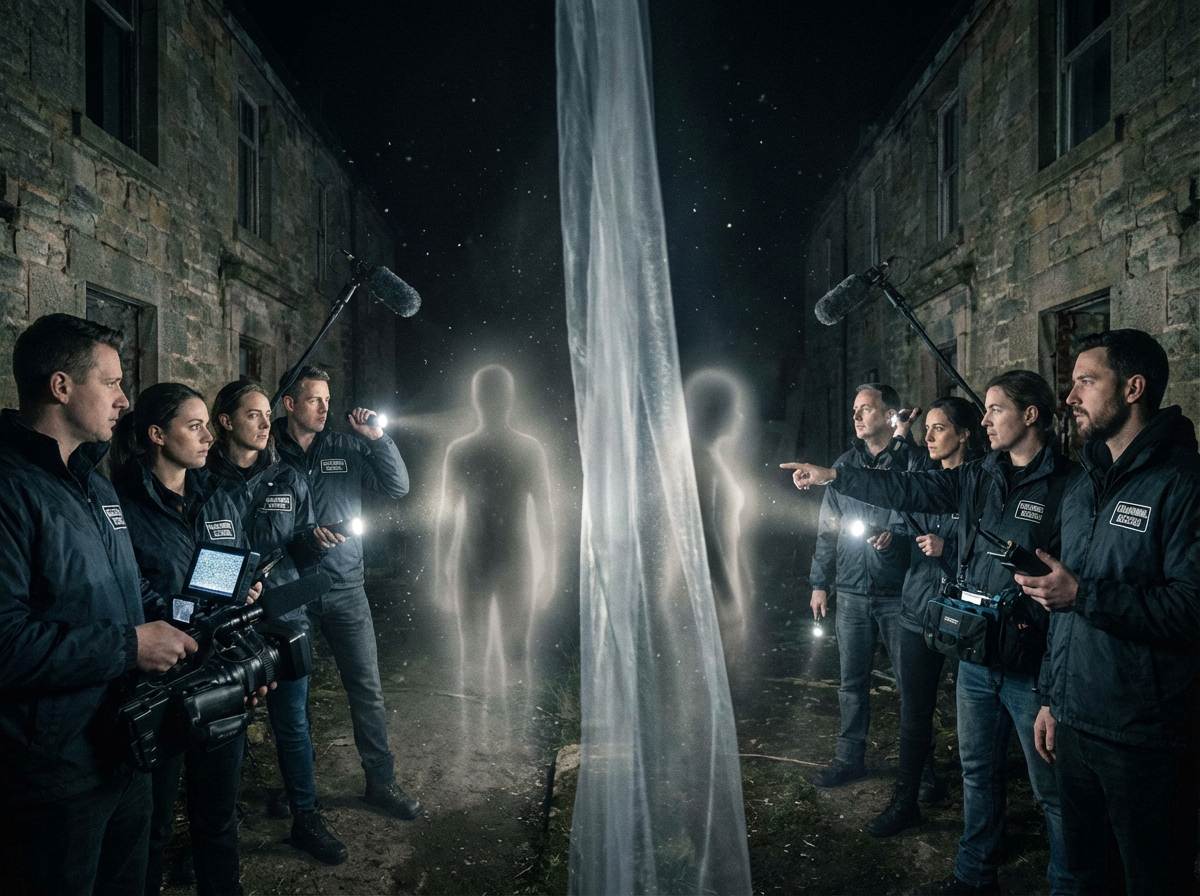
What if every time a paranormal investigation team enters a dark, abandoned building with cameras and recorders, there’s another team doing the exact same thing in a nearby dimension? What if the “ghosts” each side detects are actually the other investigators, barely bleeding through the thin boundary between their realities?
In this thought experiment, hauntings are not the dead reaching out from beyond. Instead, they are mutual misperceptions between two sets of living people, separated by a small dimensional offset. Both teams think they are hunting spirits. Both teams experience strange sounds, flickers, and voices. And neither realizes they are encountering one another in a distorted, fragmentary way.
This article explores that “what if” scenario using three main ingredients:
- Basic ideas about multiple realities and overlapping universes
- Limits of human perception and why we only ever see a sliver of what exists
- Occult and magickal ideas about layered worlds and tuned consciousness
The goal is not to tell you what is true, but to build a coherent alternative model of hauntings. At the end, you can decide for yourself whether this idea is pure fiction, a symbolic metaphor, or something that might contain a hidden grain of truth.
1. Two Teams, One Space
Imagine a familiar scene from a paranormal investigation. A team walks into an abandoned hospital at night. They carry electromagnetic meters, infrared cameras, and digital recorders. They ask the usual questions: “Is anyone here with us? Can you make a sound?”
Now duplicate that hospital in another dimension. In that slightly different version of reality, another team arrives at what they also believe is an abandoned, haunted location. They bring similar equipment, ask similar questions, and wait for something to answer.
Neither team is aware of the other universe. They experience their world as solid, complete, and self-contained. But in certain places, the fabric of existence is thin. The two versions of the building partially overlap, not all the time, but in brief, unstable flashes. Through those tiny cracks, just a small amount of information leaks from one side to the other.
On our side, this appears as:
- A shadow that crosses a doorway on camera for a single frame
- A sudden spike on an EMF meter with no obvious local cause
- A faint voice captured in a recording when no one in the room spoke
On their side, the same events appear in a similar way. To them, we are the ghosts:
- Our movements become their shadows and partial figures
- Our equipment emits the strange EMF spikes they cannot explain
- Our whispered questions bleed into their audio as distorted voices
From this angle, a haunting is not a one-sided event. It is a two-way encounter between realities, with both sides convinced they are studying the spirits of the dead, when in fact they are chasing living people from another dimension.
2. Parallel Worlds and Overlapping Realities
To make this scenario feel at least somewhat grounded, we can borrow ideas from modern physics and metaphysics without claiming they literally prove anything. The point here is to create a model that is internally consistent, not to declare a final answer about paranormal phenomena.
2.1 Branching Realities
One idea from physics suggests that reality may branch into countless versions, with different outcomes playing out in parallel. In this view, every choice, every random event, and every quantum-level possibility can lead to a new branch of the universe. These branches are usually assumed not to interact in any obvious way, which is why we experience only one continuous timeline.
However, in our speculative scenario, we imagine that this separation is not perfect everywhere. There may be rare locations where the boundary between branches is slightly weaker, where interference patterns still exist. The hospital, the battlefield, or the old prison that people call “haunted” could be one of those places where the branches come unusually close to each other.
In those overlap zones, small fragments of one world might appear in the other:
- A light source in one universe becomes a faint glow or lens flare in the other
- A voice in one dimension drifts through as muffled static in the next
- A person moving around in one reality shows up as a blurred, translucent figure in the other
2.2 Interdimensional Visitors vs. Local Neighbors
Some people who study strange phenomena like UFOs, entities, or apparitions talk about “other dimensions” rather than distant planets or conventional afterlives. They suggest that some “beings” might come from parallel layers of reality that overlap with ours. In our scenario, this same concept is applied to something much more mundane: other human beings, just slightly displaced.
Instead of angels, demons, or extraterrestrials, the visitors across the veil are essentially mirror versions of ourselves, living in similar cities, walking similar streets, investigating similar “haunted” places. To them, we are the spooky figures and unexplained noises. We are the incomprehensible “voices of the dead.”
3. Why We Only See Fragments
If this dimensional cross-talk is real, why do we only ever see partial forms? Why do figures appear and vanish in seconds, or show up as half a shape on a still frame? Why are voices faint, distorted, or limited to certain ranges?
3.1 The Narrow Window of Human Senses
Our eyes detect only a narrow band of wavelengths. Outside of that band, the world is full of invisible activity: infrared, ultraviolet, radio waves, X-rays, and more. Our ears also respond only to a specific slice of sound frequencies. Beyond that range, sound becomes either too low or too high for us to hear.
Even in a single universe, we are already missing most of what happens around us. Ghost hunters compensate by using cameras and recorders that can detect things beyond normal human limits. Infrared cameras see heat patterns. Full-spectrum devices pick up more of the electromagnetic spectrum. Audio recorders can hear faint sounds that our ears ignore or filter out.
Now imagine another dimension overlapping with ours:
- The matter in that universe may interact with light differently from how matter in ours does.
- Their devices may operate at slightly different frequencies or intensities than ours.
- The overlap between the two worlds might be too weak to create clear images or sounds.
The result is that we get only fragments. A shoulder without a face. A moving blur without clear limbs. A voice with only every third syllable audible. Our brains, designed to create meaningful patterns from incomplete data, fill in the missing pieces and form recognizable shapes: a person, a whisper, a presence.
3.2 Flickering Overlaps and Persistence of Vision
Our perception is not continuous. The brain creates an illusion of smooth experience by stitching together frames of sensory input over time. This is why fast sequences of still images appear to move, and why lights flickering at high speed look steady.
If the dimensional overlap between universes is unstable, it might act like a flickering signal. For a fraction of a second, the connection is strong enough for information to cross. Then it weakens. Then it strengthens again in another spot. To our nervous system, this appears as:
- Figures that “jump” from one position to another
- Apparitions that are present one moment and gone the next
- Strange motion that does not follow normal rules of walking, turning, or standing
The same would apply on the other side. To them, we are the discontinuous, gliding shapes. Each world’s observers sew together these broken flashes into stories: ghosts, spirits, echoes of the dead. The underlying reality, in this scenario, is that each side is briefly peeking into the other’s present.
4. The Equipment Reinterpreted
Most paranormal teams use similar gear. They carry meters for electric and magnetic fields, digital audio recorders, motion sensors, temperature probes, and a wide variety of cameras. Let’s reinterpret how this equipment might behave if it were detecting leaks from another dimension rather than communication from the dead.
4.1 EMF Spikes as Dimensional Shadows
Electromagnetic field meters respond to changes in the strength of local fields. In everyday life, those changes come from power lines, electronic devices, wiring in the walls, and natural sources. During an investigation, spikes that appear without an obvious cause are often treated as signs of a presence.
In a dimensional overlap model, an EMF spike might be:
- A shadow impression of a device in the neighboring universe, like a radio or phone.
- Feedback from their own detectors bleeding into our space.
- A moment when the boundary between realities allows a portion of their environment to influence ours.
The team on the other side could be seeing similar spikes and interpreting them as proof of a haunting in their world. Both teams, in effect, are reading each other’s equipment as supernatural.
4.2 EVPs as Cross-Dimensional Audio
Electronic Voice Phenomena, or EVPs, are sounds captured on recordings that were not heard at the time. Typically, investigators ask questions and later review the audio for faint replies, short phrases, or single words. These messages are usually weak, distorted, and open to interpretation.
If two teams in different universes are simultaneously trying to contact whatever is “out there,” their voices might leak across the boundary in scrambled form:
- Your question in one universe becomes a faint, half-heard murmur in the other.
- Their answer in their reality becomes a garbled whisper in your recording.
Each side might hear phrases like “Get out,” “Help,” or “Yes,” partly because of real sound patterns, and partly because the human mind is excellent at finding words in noise. In this model, EVPs are not messages from the dead, but imperfect cross-talk between the living in different dimensions.
4.3 Moving Objects and Mutual Disturbances
Sometimes investigators report that objects move, doors close, or small items shift positions with no visible cause. These are often called poltergeist-like events. In a dual-universe haunting, such disturbances could occur when:
- Objects exist in both universes in slightly different positions.
- One side interacts with the object, nudging the shared structure it occupies across realities.
- The other side sees the object move with no one near it.
From our point of view, this is a sign of an unseen agent. From their point of view, we are the unseen agent. The physical environment becomes a shared interface between dimensions. Basic actions, like leaning on a table or touching a door, create mysterious events on the other side.
5. Residual vs. Intelligent Hauntings
Many paranormal frameworks separate hauntings into two main types:
- Residual hauntings, where events replay like a recording and do not interact with the observer.
- Intelligent hauntings, where something responds to questions, requests, or provocations.
This division still works in the dimensional overlap model, but with a different interpretation.
5.1 Residual: Echoes of Other Times
In a residual haunting, people often see the same figure repeat the same actions: walking down a corridor, climbing stairs, looking out a window. The figure never reacts to anyone, never changes behavior, and never seems aware that it is seen.
In a multi-reality perspective, residual hauntings could be:
- Echoes of past events in a neighboring timeline that periodically align with our location.
- Patterns imprinted in the structure of the environment that re-create the shapes and motions of former inhabitants.
- Overlaps not with another present, but with another time entirely, in either our universe or another one.
The people whose actions are being “seen” are not spirits. They are long gone in their own reality. The pattern of their movement, however, remains encoded in the combined structure of matter, space, and energy. When conditions are right, that pattern becomes visible again, like a hologram half-illuminated by the light of our present.
5.2 Intelligent: Real-Time Mutual Contact
In an intelligent haunting, investigators receive what appear to be real-time responses. They ask for knocks, and knocks occur. They request that lights be turned on or off, and this happens. They ask questions and sometimes hear meaningful words in reply.
In a two-world scenario, this type of haunting might occur when:
- Both universes are aligned strongly in the same place at the same time.
- Both teams are actively trying to communicate with whatever they think is present.
- Each side’s actions partly influence the other side’s environment.
You say, “Can you knock twice if you can hear me?” On the other side, a team hears a faint voice or noise, becomes uneasy, and one of them shifts, bumps a wall, or taps something without thinking. In your universe, that bump registers as exactly the response you requested. On their side, your reaction might provide a mirror response to questions they have asked. Both teams walk away convinced they spoke with a conscious nonhuman entity.
6. Ritual, Magick, and Tuning the Signal
Beyond gadgets and scientific vocabulary, there is the world of magick, occultism, and ritual. Many traditions describe reality as made of multiple layers or planes: physical, astral, mental, spiritual, and more. Ritual practices, meditation, and altered states of consciousness are said to allow practitioners to move awareness between these layers or call beings from one plane into another.
6.1 Magick as Phase Adjustment
If we borrow the language of waves and phases, a ritual can be seen as an attempt to bring the magician or witch into a particular alignment with an unseen level of reality. Symbols, gestures, sacred names, and focused intention all work to shift the practitioner’s inner state. At the same time, the physical setup—candles, circles, geometric patterns—might be viewed as a way of structuring the space to favor certain types of interaction.
Within our interdimensional model, these practices could have the effect of:
- Temporarily changing how the practitioner’s mind and energy interact with the boundary between universes.
- Strengthening certain kinds of cross-reality signal and weakening others.
- Creating a stable “window” where contact with another dimension is more coherent than during random hauntings.
From the inside, this feels like summoning a spirit, deity, or otherworldly helper. From the outside, it might look like something in another layer of existence suddenly perceives someone calling out and attempting communication.
6.2 Spirits as Others, Not Necessarily the Dead
Many occult traditions already assume that spirits are not simply the souls of deceased humans. Some entities are considered to be elementals, nature spirits, or thought-forms created by collective belief. Others are seen as vast intelligences that transcend human life cycles entirely.
In a dimensional-chase framework, some of these “spirits” might be:
- Conscious beings in other realities, whose nature is unlike our own.
- Large-scale patterns of mind or energy spread across multiple dimensions at once.
- Fragments of other civilizations or timelines that briefly interact with our awareness.
In this view, paranormal investigations and occult rituals are part of the same larger project: attempts by human beings to reach beyond the everyday physical world. Whether we call what answers “spirits,” “entities,” or “other-dimensional observers” depends on the story we choose to tell.
7. Haunted Places as Stress Points in Reality
Why do certain places gain reputations as intensely haunted while others remain quiet? Traditional answers emphasize tragedy, violence, or burial grounds. Geology-focused theories point to things like mineral content, underground water, or fault lines as influences on paranormal activity.
In the dimensional-overlap model, such locations could be:
- Regions where the boundary between nearby realities is thinner or more unstable.
- Intersections of natural energy flows, human emotion, and complex environmental structures.
- Points where multiple timelines or branches share similar events, increasing the chance of cross-talk.
A battlefield, for example, might be a place where countless versions of similar events occurred across many realities: marching, fighting, fear, pain, and death. The intensity and repetition of those events could correlate with structural stresses in the fabric of space and time. As a result, glimpses of other versions of that field, or other soldiers and witnesses, might leak through into our perception.
8. What It Feels Like on Both Sides
To make this more vivid, imagine the experience from the viewpoint of a single investigator in one universe.
You stand in a dark hallway, light only from your camera’s display. The air feels heavy. You ask, “Is anyone here who wants to speak?” The room stays silent. Minutes pass. Later, while reviewing the audio, you hear a soft voice that seems to whisper something. You cannot make out the words. It feels like a presence is trying to reach out.
Now shift to the other universe. There, another investigator stands in their version of the same hallway. They feel a chill and a sense of being watched. They ask their own question: “Who are you? Why are you here?” On their recording, a faint voice appears as well. It is our question, distorted by the boundary. To them, we are the ghost.
Neither side has enough information to know the truth. Each fills in the gaps using their beliefs, culture, and expectations. One person interprets it as contact with a spirit. Another calls it an echo of the past. A third describes it as interference from another dimension. The underlying sensory data is the same; the story built around it is what changes.
9. Could Any of This Be Tested?
This entire scenario is speculative. It is a creative thought experiment rather than a proven explanation. Still, it is worth asking what kinds of clues we might look for if such dimensional overlap existed.
Possible lines of investigation could include:
- Looking for patterns in timing and repetition. Do certain locations reliably produce similar anomalies under the same conditions, suggesting a stable structural cause?
- Standardizing investigation methods across many teams to see if similar “responses” occur at the same time of night, during similar weather, or under particular environmental conditions.
- Experimenting with synchronized investigations. For example, two teams in different locations might follow the same sequence of questions and actions and look for unusual correlations.
- Combining scientific monitoring with ritual or meditative practices to see if changes in consciousness appear to affect the rate or clarity of anomalies.
None of these would guarantee proof of other dimensions, of course. Strange results could be explained by instrument error, psychological suggestion, or hidden environmental factors. However, such experiments might help refine how people think about hauntings, whether in entirely conventional terms or in more exotic ones.
10. Drawing Your Own Conclusion
This “what if” perspective on paranormal investigations turns the usual story inside out. Instead of humans visiting haunted places and being observed by dead spirits, we imagine living people in multiple realities studying each other without realizing it. Each team thinks it is alone with ghosts. Each team treats the other as evidence of an afterlife or some invisible realm. In fact, the “ghost” in the room may be someone very much alive, just displaced to another layer of existence.
Whether you find this idea believable, metaphorically interesting, or entirely fictional is up to you. On one level, it is just a creative way to blend concepts from physics, perception, and occult philosophy into a single narrative. On another level, it raises deeper questions:
- How much of reality do we really perceive at any given moment?
- How do our beliefs shape the stories we tell about unexplained experiences?
- What would it mean for our understanding of life and death if some “spirits” were actually neighbors in a cosmic apartment building of overlapping worlds?
Some readers might take this model as pure science fiction, an entertaining exercise in imagination. Others might see it as a symbolic framework, expressing the feeling that something about hauntings and apparitions is more complex than the simple idea of “the dead returning.” And a few may wonder whether, late at night in a quiet building, when the EMF meter jumps and a whisper appears on the audio, someone in another dimension is pointing a recorder in our direction and asking the exact same question:
“Is anyone here?”
In the end, this article offers a possibility, not a verdict. The next time you hear a story about a ghost hunt, see a shadow figure on a video, or feel that strange sensation of being watched in an empty room, you can decide which explanation feels right to you: spirits of the dead, tricks of the mind, glitches in our measurements, or a brief, eerie moment of contact with ghost hunters from another world, just as curious and confused as you are.